

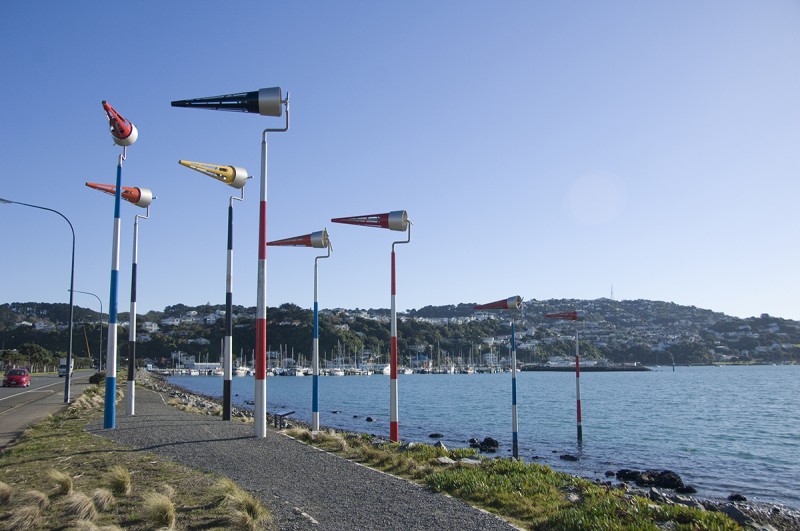
Photo courtesy of Wellington Sculpture Trust
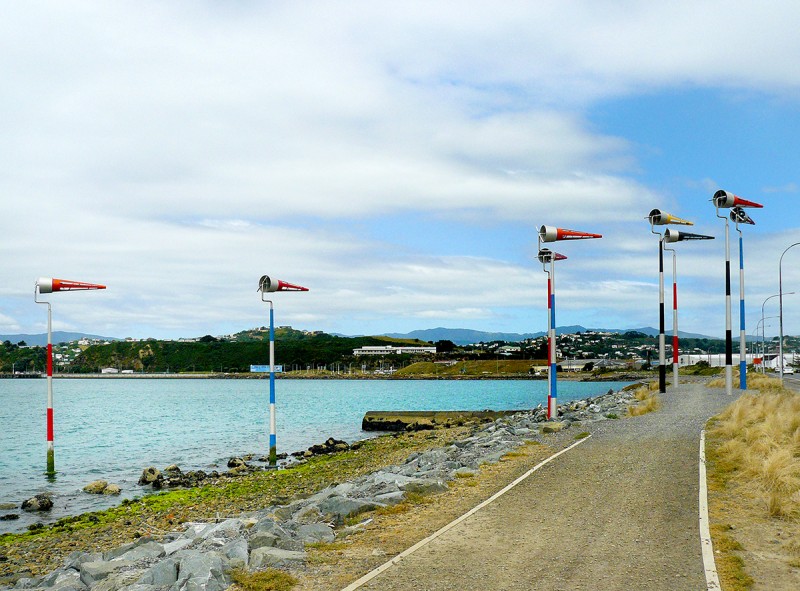
Photo courtesy of Wellington Sculpture Trust
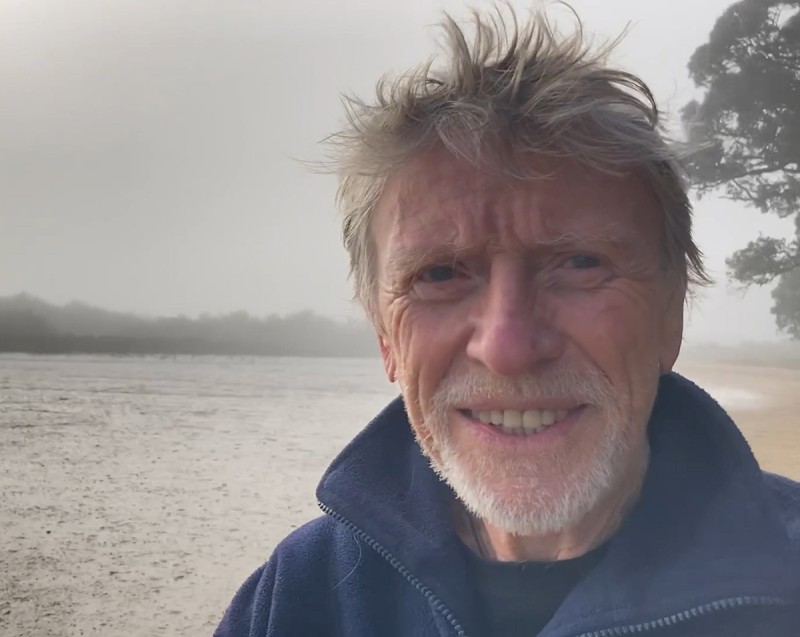
Phil Dadson ONZM
Ākau Tangi by Isabella Smith
In this series, Isabella talks to the artists behind the sculptures dotted around our city.
The tectonic upthrust that raised the seabed and lifted the Rongotai isthmus from out of the harbour feels like a good place to start when talking about Phil Dadson ONZM’s sculpture Ākau Tangi, located on Cobham Drive by the airport. The hard consonants of rock grinding against the shore, the whipping wind, the crashing waves all form the wellspring from which Phil drew his supply of inspiration.
Materiality and motion are recurring elements in the multi-hyphenate sound and intermedia artist’s work. As an inveterate collector of things with a huge range of interests in prehistory, ethnography, spiritual traditions, and the diversity of natural and sonic worlds, his concepts are realised in a variety of forms: building musical instruments and sonic objects, composition, improvisation, experimental filmmaking, sound and kinetic sculptures, installation, and graphic works.
Phil works in the realm of the ephemeral. A deep listener with poetic and scientific sensibilities, he captures and translates the earth in conversation with itself. Growing up in Ahuriri near Napier, Phil recalls the sounds of the turbulent coastline within earshot of his family home. “The sound of shingle on shingle and heavy seas going up and down the beach. The shifting landscape,” he says. “Corporeality, body-based kinetics, vibration and rhythm, they’re pretty much at the core of all that I do – not so uncommon as it is pretty much the core of our existence on this planet,” he says.
Cobham Drive runs down the side of the airport connecting Kilbirnie to the Miramar Peninsula. A long, straight stretch exposed to the elements and the engine thrust of planes taking off and landing, the area is more fittingly known as Ākau Tangi, which can be translated to ‘sounding coast’ or ‘crying seashore’. It is a centre of constant energy and movement, which is why the Wellington Sculpture Trust, alongside Meridian Energy, commissioned a number of artists to produce kinetic works that harness its elemental forces.
“For Ākau Tangi, I wanted a dynamic integration of motion, sound, and light in the installation of turbines transiting from land (airport) to ocean (harbour).”
Installed in 2010, the sculpture consists of 12 birdlike windsocks that migrate from the land, crossing the road onto the median separating east and westward traffic, and down into the sea. These sentinels swivel with the wind, alert to the changing weather and tides.
The ancestor of Ākau Tangi was created in 1971: a set of 10 white cotton windsocks and bags of coloured dye that were suspended on five tensioned wires across a section of Grafton Gully in central Tāmaki Makaurau.
“As the windsocks hurtled from one side to another in the wind, they became colour-splattered from banging into the bags of various coloured dyes, and eventually over time disintegrated, all part of the intent as an ephemeral work.”
“The brief in Pōneke of course had to be more permanent,” Phil says. “Hence the engineering complexity of the installation.”
The original concept featured a wind-activated lighting system, with each windsock glowing in varying shades of blue, green, or red when the wind speeds were high enough. The highly engineered turbines also had sonic features. Sets of tubular, flute-like instruments played by the wind were installed on each pole in association with the spinning turbine. When heard together, they whistled and moaned in an ever-changing low-level harmony that joined the natural cries of the coast.
“In terms of pure sound, I am attracted to intricate texture; the microscopic, the unexpected, the naturally rhythmic and the adventurous; to sound atmospheres and layered perspectives, to sounds that conjure mood and imagination, that convey ideas and express the human heart and soul,” Phil said shortly after Ākau Tangi was installed.
The sculpture needed to be able to survive the exposed environment, respond to the wind smoothly, and to gather sufficient speed to generate enough power to activate the lighting system. The wind turbines are made from sheet aluminium, the weathervane component is made of aluminium tube, and the poles, in an octagonal tapered design similar to streetlights, are made of light steel.
“In collaboration with the engineering firm I worked with, we firstly made tests at Auckland University's wind tunnel, then, and more successfully, with a turbine unit mounted on the back of a ute driven at around 130 kilometres around a racecourse.”
This kind of play, exploration, and risk-taking are integral to Phil’s work. “That’s also true of much of the graphic work I do. It’s often in the moment, spontaneity sort of stuff. It’s trying a new technical approach to something, playing with it to see what happens, developing it, then deciding, hey, don’t take it any further – it’s working now.”
While there was a huge amount of preparation that went into Ākau Tangi, it was ultimately a prototype. “You can’t really pretest everything until you get the final thing up, and that’s why the piece did create some problems along the way.” Sadly, the lighting features died one by one over 18 months, and the sonic elements were returned to Phil due to noise complaints, though the birds continue to turn on their axis, caught between Tangaroa and Tāwhirimatea.
Phil tells me that he’s stepped back from public art per se – though he appears to be no less busy – favouring time-based works over more permanent structures. A new film, From Scratch: Songs for Unsung Heroes, came out in July this year. Directed and edited by John Pain, it is a cinematic live concert experience of Phil’s renowned experimental music ensemble From Scratch performing at Kāhui St David’s in Tāmaki Makaurau.
Currently perched on the rooftop of the Len Lye Centre are two wind-activated aeolian harps that harmonise in accordance with the weather, created in collaboration with James McCarthy. A climate piece, it maps the changing weather patterns of the area with controllable surveillance cameras and audio recorders that transmit imagery and sound into the gallery space.
“It was the first time that they’d ever agreed to have anything mounted on the roof, a brave decision given the challenge of unpredictable weather and secure maintenance of the harps.”
A seminal character in Aotearoa’s art history, to engage with Phil’s works is to become aware of the primordial gods that play out their dramas here on earth, causing storms to brew, tides to swell, and the earth to shift. The senses become blurred, metaphors are caught mid-action, and we are presented with the magic, reverberating resonance of nature.
View more articles from:
« Issue 278, October 6, 2026