
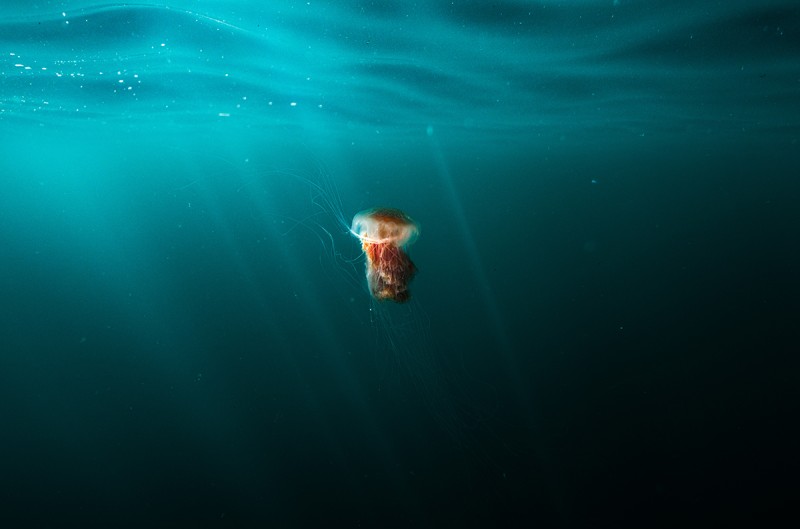
Whimsical Lion’s Mane by Ricky Situ
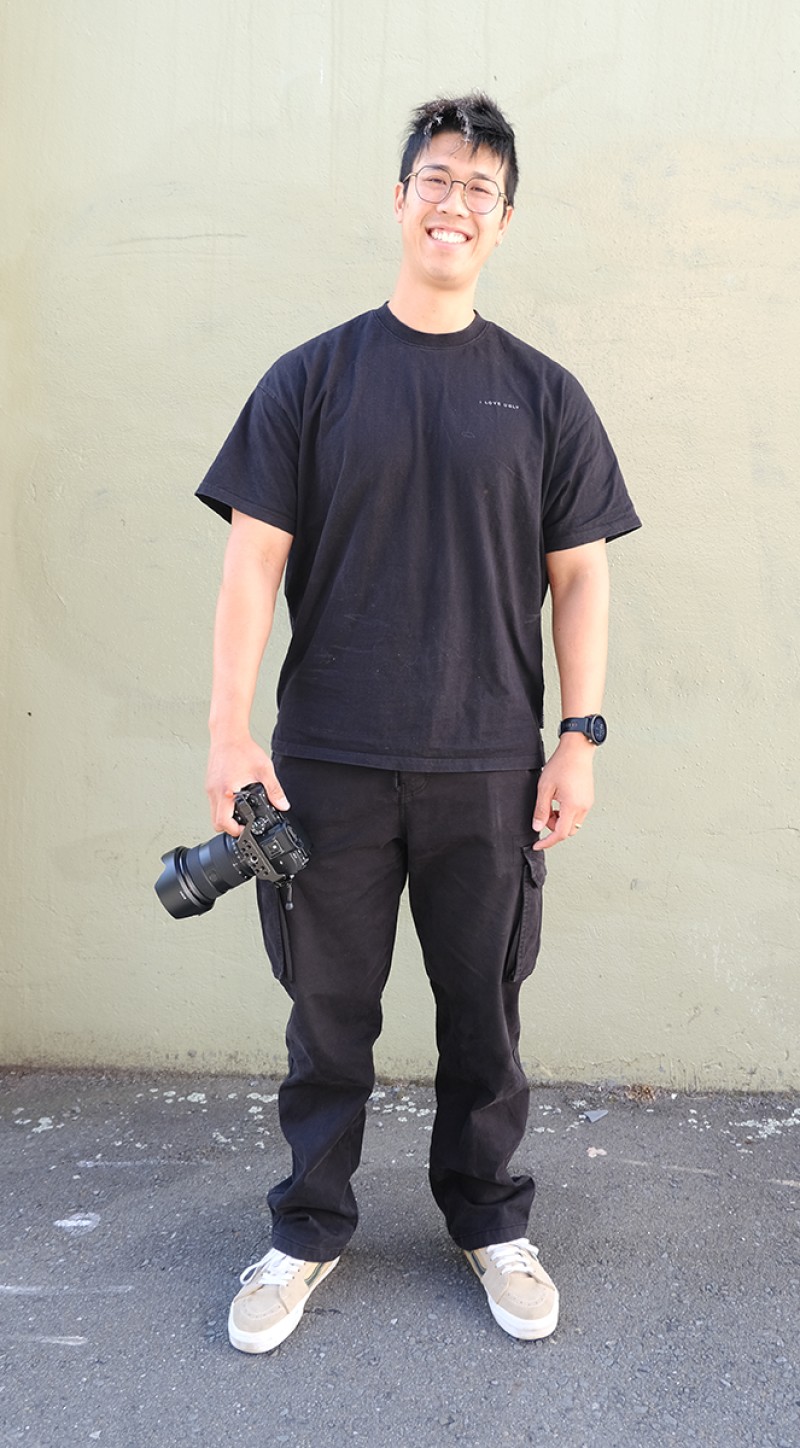
Camera and a spear gun by Isabella Smith
For 26 years, the Tūhura Otago Museum Wildlife Photography Competition has been an Otago-only affair, inviting amateur photographers to send in their best wildlife, landscape, and botanical shots. This year the annual competition opened a new nationwide category called Wild Aotearoa, which made up about 5000 of the 9000-plus submissions sent in.
Wellington photographer Ricky Situ was named runner-up Wildlife Aotearoa Photographer of the Year with his stunning image Whimsical Lion’s Mane. A stunning image of a solitary jellyfish lit up by sunlight that filters through the water. We caught up last week to discuss photography, wildlife, and life outdoors.
Tell me about how you got the shot of the lion’s mane?
I do a lot of fishing and diving as a hobby. Generally, I go out to Kāpiti, along the South Coast, Mākara Beach. I do photography as a job and as a hobby as well, so I always take my camera out into the water to take photos.
When I’m out, I do a bit of fishing and photo taking, about half and half. On this day we were out in Kāpiti. During that time of the year – around this time last year – you get lots of jellyfish floating around you. There are some pretty big lion’s mane jellyfish. This particular one was a little one, but it had some really cool colours, and the water was really calm and glossy at the top close to the surface. I called out to the boat guide Scott to give me my camera, then I quickly swam back and tried to find the jellyfish again and grabbed a few shots of it.
Do you mostly shoot underwater?
Not really. I just focus on anything that looks good. I’m a candid photographer. I think my interest in photography is naturally drawn towards nature, from being out there quite often either fishing or in the bush. I always carry my camera around and when the opportunity is there, I'll hopefully grab it at a good angle.
What drives your wildlife photography? Is there a philosophy behind it?
I hadn’t really thought about it too much, I guess I just like doing it. It’s part of my life now. I feel like it’s an obligation for me to have a camera with me wherever I go, to be able to capture anything that looks good, to celebrate animal life or a beautiful scene. I try to freeze it in a frame and have it as a photo.
Are you a bit of a gear head when it comes to camera equipment?
There’s being a gear head but also, there’s a mentality of working with what you have. I guess coming from the industry of taking photos, I’m looking at all the gear and equipment that you can get – it’s just endless. But no, I think I’m more in the mindset of: whatever you have, try to make the most of it. You don’t need the flashiest camera to take a nice shot.
What are those close encounters underwater like?
Being underwater, it’s a really different world. It's not your day-to-day. You know, wake up and go to work, see birds and mammals and things on dry land. When you go underwater everything is quite fluid. The terrains are rugged. You see weird, wavy shapes, and there’s an abundance of animal life. You’ve got schools of fish and, when you look closely, you see nudibranchs (which are like little slugs), shellfish, crayfish, pāua, sea anemones. When you swim up to the reef, it’s lit up with different colours.
Has this award encouraged you to pursue wildlife photography more?
You know, it does encourage me a bit. But I love taking photos out in nature anyway. There were about 5000 others who submitted into that category. So that was quite cool to know that [the judges] took interest in the shot I took. There were heaps of really cool other shots by other people. But, you know, you’re always your own worst critic.
I never think of taking a shot to win something, I just take it. For me, it’s always about trying to make nice shots to look back on. To show people what I get up to and show those who aren’t into diving the kinds of things we get to see.
Do you have any stories about a close encounter you’ve had when you’re out?
We were out on a hunting trip last Friday in the Aorangi Ranges. It’s the roar season at the moment and we were out hunting, pushing through the bush. We happened to bump into a female deer who was grazing. We were really close, probably like 15 metres. The sun was behind our backs, and we had just shot a deer and were covered in its scent. I suppose it masked our human scent, so the deer didn't notice us. We were slowly trying to make more noise so it would look our way. And we called out, doing the roars calls, and it still didn’t really react, so I thought maybe it did notice us but just thought we were another deer.
It’s cool that through your photography you bring hunting and fishing experiences to people who haven't gone on those adventures.
Yeah exactly, they’re cool experiences. You can document it on your phone, but having a camera, you can compose the image.
Also, with a digital camera, you can be trigger happy – which feels like a bit of me right now. With the fast shutter, you can capture little micro moments. Sometimes when people are moving and talking and whatnot, their eyes close and you might capture a funny half expression. Taking heaps of shots in that moment, you can capture the whole process and get a better image out of the burst.
With the shot of the jellyfish, it looks so well curated. But it seems like you just go with the flow.
Yeah, it really was a small moment in the diving day. Later on when I was editing it I thought, ‘sweet this is a really cool image, I just needed to pump up some colours.’ When you take photos in the water, the light refraction cuts out certain colours. The deeper you go, the more reds and oranges get taken out of the photo. It's quite washed out when you have the raw photo. It can initially be quite a grey, sad looking shot.
When you edit, you play with colour saturation and push the image back into the purple, orange, and red end of the spectrum to make the jellyfish stand out a little bit more.
Taking photos of wildlife must take a lot of patience.
Yeah, you just wait for the moment. You won’t find it if you’re looking for it too hard. Things won’t come along in the moment that you want them to. You can't really expect it, just be ready to take the photo when it’s there.
I miss a lot of moments because I’m not holding the camera 24/7. Sometimes I’m just diving for something to take home and I don't have my camera with me. I’ll allocate the last quarter of my dive to hold the camera and swim around. But most of the time I miss things like dolphins coming by or having a really big school of fish swirl around me. I’m constantly torn between the two. I can’t hold a giant camera and a spear gun.
View more articles from:
« Issue 266, April 21, 2026