

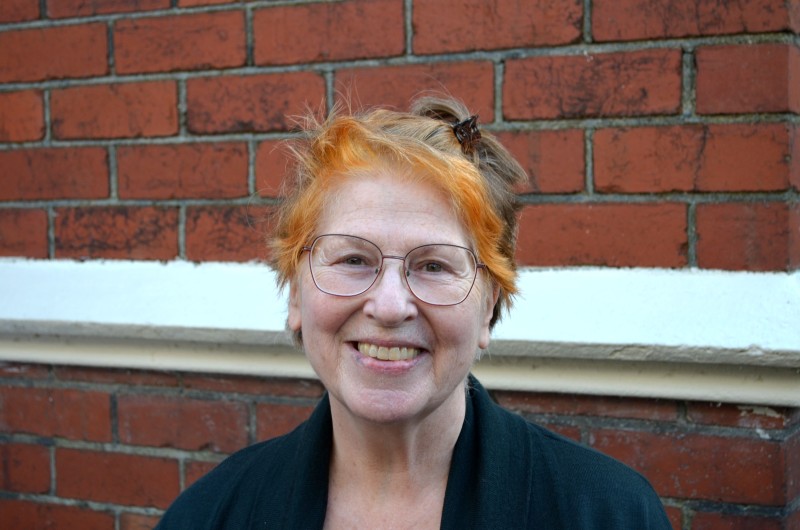
Familial faultlines by Isabella Smith
Writer, photographer, and filmmaker Gayna Vetter’s just-launched debut novel Residual Images is set in the 1980s and follows 27-year-old photographer Etzel Baumann, a woman more comfortable in the darkroom than amongst her kin, living in self-imposed exile in Hornby, Canterbury. With the potential loss of her second parent, she returns to the American Midwest. There she finds a rusty trunk containing old photographs of her family: generations of Eastern European immigrants. With each new image, faultlines in the family narrative reveal themselves.
I caught up with Gayna to discuss the new book and the many forking paths she encountered to arrive at what author Lawrence Patchett describes as a vital, vivid, and unusual “exploration of family and identity, revealing a lot about the warping power of secrets, poor communication, and damaged love”.
Photography is a great tool to access memory. How does that play out in Residual Images?
I found some photographs when I was home after both my parents died; this trunk just showed up in the middle of the room with all these wonderful pictures in it. I didn’t know these people, but when I looked at them, I recognised features. I saw where we came from, places like Czechoslovakia and Bessarabia – which is now Moldova – and Ukraine. There were some of my great, great, great, great-somethings threshing in Ukraine. And I thought, ‘How can that be?’
I studied photography as a bachelor’s degree. ‘Images speak a thousand words’ – there’s a truth to that. I have always found pictures fascinating. Henri Cartier-Bresson’s ‘decisive moment’ always bothered me. He said when you snap a picture, the picture has one place it’s supposed to be. You snap the perfect moment. I disagreed with that because I thought there’s so much going on beyond the frame.
Initially, I wanted to write about photography. You know, film photography and what it’s like being in the darkroom. But when I started writing it down, it was too academic. I’d been working in the university for a long time. But you can do so much with photography. You stew things up and make something that’s not totally realistic. It’s marvellous. I thought, when I start to write more, let’s do that.
How did the story shift?
The story’s been in my head for a long, long time. I’ve been talking about it for almost as long as I’ve been here.
When I signed up to a Whitireia creative writing course in 2014, I had a concept of three sisters in a family born 20 years apart. That’s true in my life. I have a sister 10 years older and a sister 20 years older within a family of eight. We were born between 1936 and 1956. You think of that difference in times: same house, same parents, same community, same school, same everything. We’re quite different, but we’re also quite alike. So, I put those two things together, the photographs and the sisters.
It was initially going to be more like creative non-fiction. I had always wanted all of us to write about our lives growing up in that house. I decided I’d write mine. I wrote a first draft, and it was a terrible first, but I got some ideas. Then I did an advanced and a graduate diploma. In the second year, I had Mandy Hager. She has a way of motivating everybody and giving everyone her heart. She really saw what I was trying to do and that spurred me on. By 2016, I had a completely different story. Etzel, my character, had come to life. It changed into fiction because she took over. She woke me up one night and said, ‘You don’t get me, do you?’
I decided to really emphasise the fictional part of the story and concentrate on her. The pictures were good. But I wasn’t bringing it together. I moved into my office and basically lived it. I slept on mats on the floor. When I’d wake up in the night, I could write things down and I wasn’t disturbing anyone.
I made the magic by Etz being able to see the before and after of a decisive moment. She’s breaking the frames and seeing what happened. I concentrated myself on the photographs first, and then I worked the frame story around it – the present-day story – and brought history into a linear narrative. That’s when I started looking into abuse, and how a person would behave, and the story changed. It changed from me trying too much with the photography to accepting those stories and making them behave like a film for Etz to witness her life, and to change her in some way – you know, the arc of a character.
Could you speak about exile and movement?
I moved here from the States 40 years ago, and that was a move of choice. Whereas Etz is forced out. She doesn’t have a choice. When I was writing the book, a lot of people said I had to have a happy ending. But I think if it’s a happy ending, it’s not the end. Some of the hardest things in life are some of the best things in life.
I love that the lines cross. I like the fact that we came from Europe. My great-grandfather moved from the centre of Germany to Bessarabia when Catherine the Great opened up land in Russia. Then the same family came to the United States. Some in my family then moved away. I’m the one who’s probably moved the farthest in a generation. There’s a fear of leaving America for some of them.
But I got itchy feet. When I came to NZ, I sold up everything and packed my bags. I wondered if my ancestors who did all that moving, like that great-grandfather, if they were like that. Because he then moved from North Dakota to California. Etz too, she chooses exile. She wonders whether she’s one of those people who just has to wander.
How did you go about the research?
There was enough written on the back of the photos. One cousin of mine did quite a thick book. He talked to my father and his brothers and sisters and they told stories. They were first-generation Americans who grew up homesteading, speaking German, and having to ride horses to school.
I did look into abuse in the Midwest. In the German Russian area where we settled, people are very staunch, stoic, and hardworking. They had a rough life and they were stern. It’s snowy. Then in the summertime, it’s really hot.
We had a way of being that today would be called neglect or abuse. But when I looked into it, I found Etz was going to be alright. But she needed to understand that the treatment her family gave her was abusive, because she thinks it’s normal.
Lynn Jenner described there being a slightly scary form of wit throughout the book.
I think I write naturally in a sort of Anne Tyler-ish way. Her writing is very Midwestern. It’s just a normal way of talking for us. ‘This is the way that life is, and this is ‘ha ha’ how it is.’ I'm not really sure which part Lynn is talking about, maybe when Etz says things like, ‘Everybody knows that you don’t look into a barrel of a gun when you’re cleaning it.’
The humour was important to show that Etz is alright, as long as she still has her humour. And I believe that.
View more articles from:
« Issue 277, September 22, 2026