
Keep curious by Madelaine Empson
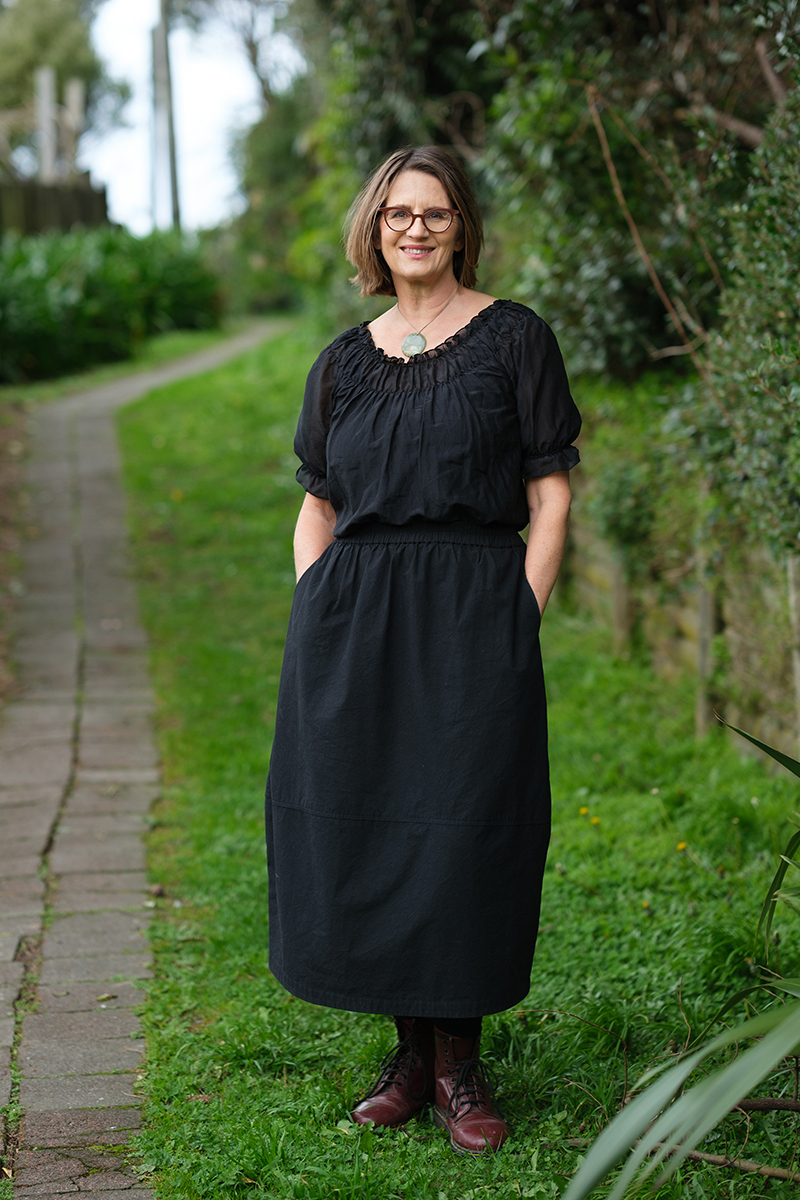
Vanessa Young is a science communicator, a homeopath, and a first-time author who lives by the sea in the eastern suburbs of Wellington. Her debut, The Reluctant Homeopath: An unexpected science story, is a creative nonfiction tale of the tension between her science training and her work as an alternative health practitioner.
Science author Rebecca Priestley suggested the subject for the book when Vanessa took Rebecca’s Creative Science Writing course at Victoria University of Wellington – Te Herenga Waka’s International Institute of Modern Letters. The Reluctant Homeopath was published by The Cuba Press on Wakefield Street with the year-long input of six students from the Whitireia Publishing course on Dixon Street, printed by YourBooks in Grenada North, and launched at Unity Books on Willis Street on the 12th of November 2025. With local input from so many sides, “I feel Wellington has really wrapped itself around me in terms of this book”, Vanessa tells me as we sit down to talk about why she is, in fact, no longer The Reluctant Homeopath.
It seems like science came first for you?
Science was always my first love. I think I always knew I’d study science. My parents used to encourage that and pose thought-experiment type questions, and my mum always had the BBC science radio on in the background. I don’t know if she ever knew it was something that I was unconsciously listening to. I went to uni and did honours in biochemistry. I was a policy analyst within central government for most of my career, and I somehow slowly ended up in slightly more communications roles in science fields without having meant to. I’m now able to talk and write about the amazing science that is happening in New Zealand.
Your working week is as a science communicator, and on Saturdays, you run your homeopathy clinic in Miramar. For our unfamiliar readers, could you please explain what homeopathy is?
Homeopathy is challenging for anyone with a science background. Before I start, I just want to put that out there! It is based on the principle of similars, which is ‘like matching like’. So it’s unlike much of Western medicine, where you might be given something based on opposites: if you have pain, you have a pain killer; if you have inflammation, you’re given anti-inflammatories, and so on. With homeopathy, we’re going to give you something that matches your symptoms. If you come in with stinging eyes and a runny nose, we might give you a remedy made from onions. If you’re having trouble sleeping, lying in bed with thoughts going round and round in your mind, we might give you a remedy made from coffee, because we know coffee can make us wired and jittery. The second thing about homeopathy is the ultra-high dilutions, which, honestly, for anyone with a science background, is particularly challenging. So a homeopathic pharmacist will make remedies by diluting a substance over and over until it’s way past the point where chemists would say there was any of the original substance left. They go way past what’s called Avogadro’s number. I might give somebody a remedy that’s more dilute than one drop in all of the oceans of the world. Plus homeopathy takes a very holistic view of the person, looking at the mental and emotional picture as well as the physical.
When did you discover homeopathy and why did it have such an impact on you?
It would have been the mid-90s. I was really happy in my science-framed world. I loved the way science makes sense of the world in all sorts of sensible ways, and I still do. I encountered a series of people who casually mentioned to me they’d been to homeopaths and felt better afterwards. My scientific side was incredibly suspicious of this, highly sceptical. But the volume of these was such that I became curious, so I decided to study. I had no idea what was going on, but the science-me couldn’t put it down. I decided it would be unscientific not to pursue it a little bit further. There was a big pause when I graduated because it’s one thing to study, another thing to do.
It's safe to say you had internal conflict about the external conflict between the two fields?
Writing the book, I haven’t encountered any critics as tough as my own. It’s a nonfiction book, but it uses tools of creative nonfiction, and there’s a narrative piece where I set a lot of the conversations with my own internal critics and with external people in a dinner party context. I call this person Peter, who is based on someone who I found really challenging, but a lot of what comes out of Peter’s mouth actually came from my own internal critics, internal sceptics. No one was harder on me than I was on myself.
Where do you sit now in that intersect?
I did come to a place where these parts of me could cohabit comfortably. It wasn’t like there was a science-me and a homeopath-me. I am actually congruent as one. Through the book, I have come to a place where I am comfortable: I’m no longer a reluctant homeopath.
What was the process of getting your lived experience onto the page, and then getting those pages out into the world with The Cuba Press?
I’m really grateful that Rebecca suggested I try to get it down on paper. I didn’t intend to write a book, and as I was writing, I certainly didn’t know how or what it would be. It felt like the book was forming as I went along. It was simply helpful to write. I never expected to send it to anybody, but Mary McCallum [director of The Cuba Press] had heard through someone that I was writing it and asked to see the manuscript. I thought about all the things that could go wrong, but then realised that actually, maybe above all of those things, it would be worse to not try. I figured I could handle rejection, I could handle not being approved of by aspects of the world. I didn’t know at the time how incredibly lucky I was to have been approached by Mary. It was such a collaborative process. And when she told me that we were going to co-publish with the Whitireia Publishing course that year, I felt incredibly fortunate as well, because I’d have these young, clever literary people looking over the book, providing feedback and guidance.
How do you hope it will impact your readers?
I hope people keep curious. In a funny way, it’s not really a book about homeopathy. Homeopathy was kind of the case study. I realised as I was writing it that I was trying to understand: what you do when you encounter something that sits outside your worldview? How do you deal with it? I didn’t write to convince anybody about homeopathy, I didn’t write to convince myself about homeopathy, and I didn’t write for sceptics or medical people. I wrote it for people like me, who either have a science background or enjoy and appreciate the science framing of our world, which is as it should be. I’m still very much a science advocate.
Where to from here? Have you been bitten by the book bug?
The journey that I’m on – from complete sceptic (and I’m still a sceptic) to the understanding that I’ve landed on now – that journey doesn’t end. Whether I go further on, in terms of taking people with me or not, is something I’ll find out.
View more articles from:
« Issue 259, January 13, 2026