
Photo courtesy of Wellington Sculpture Trust
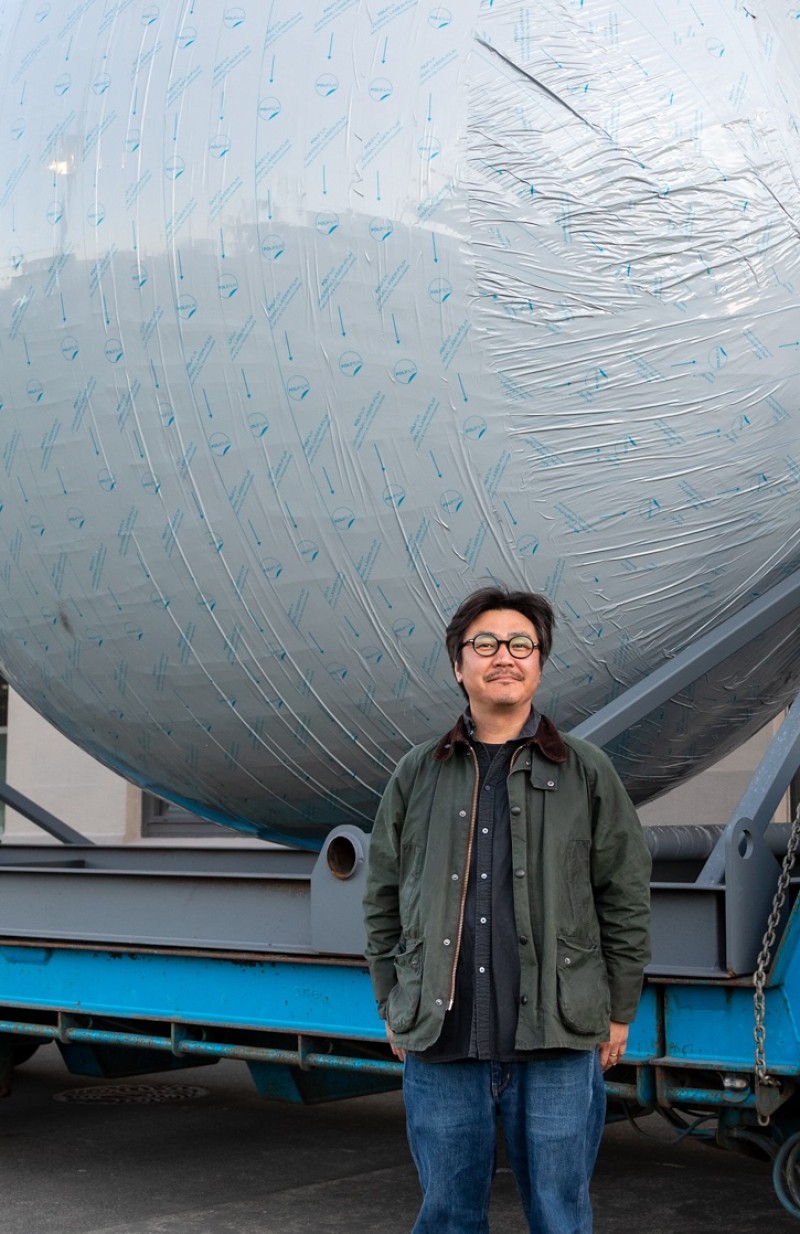
Seung Yul Oh
KIMI/You Are Here by Isabella Smith
In this new series, Isabella Smith talks to the artists behind the sculptures dotted around our city
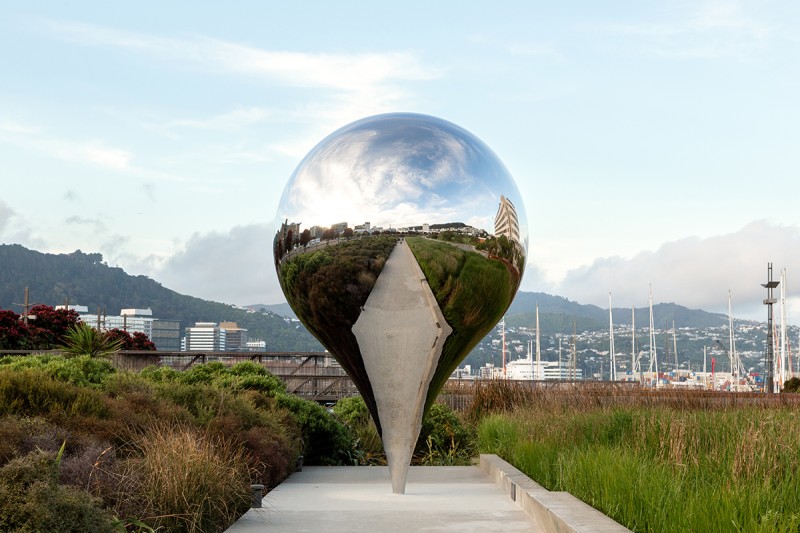
Located in the coastal planting area within the shipping dry-dock beside Waitangi Park, an inverted, stainless steel tear drop hangs suspended amidst the native vegetation. A mirror to the surrounding sky, trees, and waterfront, the sculpture reflects shifting weather patterns overhead and the faces of people standing before it.
Despite standing at five and a half metres, the softness of its curves and the purity of its surface somehow prevent it from feeling imposing. KIMI/You Are Here can be seen from many viewpoints around the six-hectare urban park, but the sculpture sits at the end of a concealed path. To find yourself staring at your own reflection is to make a small discovery, and become aware of your connection to place and to one another.
KIMI/You Are Here is like a giant location pin, reminiscent of the ones dotted over digital maps, a familiar symbol that reflects how people constantly try to orient themselves within the world. For New Zealand Korean artist and sculptor Seung Yul Oh, locating oneself is not only geographical, it is also emotional. The idea of the sculpture began with an image of releasing a small, gravityless droplet of soul into a site, “almost like a thought suspended in space”, he says. He wanted to create something intangible that could “quietly settle into the city and begin forming relationships with people, light, weather, and memory.”
“I was interested in creating something that feels emotionally open and responsive rather than fixed. Public art becomes part of people’s daily rhythm and daily weather, and I wanted KIMI to exist gently within that flow.”
Like all public works, many hands, hearts, and minds were involved in the fabrication and installation of KIMI/You Are Here, as well as an enormous amount of precision, craftsmanship, and patience. Beneath the sculpture’s smooth surface is a highly complex, rigorously calculated internal structure – with every curve and seam carefully resolved to maintain “a sense of visual lightness”. Led by Rob Janes of LT McGuinness, the sculpture took three weeks to install. The cleverly hidden foundations provide the stability needed to prevent the structure from toppling in Pōneke’s renowned gale-force winds, all the while making the sculpture appear weightless, tapering down to an elegant point where it meets the earth.
Kerry Fowler and his team of fabricators at Global Stainless in New Plymouth spent thousands of hours hand-polishing and refining the surface of the sculpture until it achieved an almost liquid-like clarity. Seung says, “I wanted the reflection to feel atmospheric rather than purely optical. As though the sculpture could absorb and release the world around it. The mirrored surface dissolves parts of the form into the sky and surrounding landscape, while the curved shape softens its physical mass. Depending on the weather and light, the sculpture can almost disappear and reappear again.”
Seung has moved between Korea and New Zealand for much of his life. Exhibiting extensively throughout Australasia and Korea, his works have become instantly recognisable, incorporating painting, installation, sculpture, video, performance, and public art. His sculptures are closely related with the way he works with other mediums, concerned with surface, rhythm, illusion, and emotional atmosphere. “Painting has especially influenced my approach to reflection and form. I’m interested in how subtle shifts in light, colour, and texture can create psychological or meditative experiences. At the same time, many of my works draw from animation, popular culture, inflatable forms, and traditional Korean aesthetics, where softness and playfulness coexist with structure and precision.”
The commissioning of KIMI/You Are Here saw the Wellington Sculpture Trust embark on its largest fundraising effort since its inception, raising $600,000 for the work. Chair of the Wellington Sculpture Trust Jane Black says the sculpture will become a place-maker, inviting people to acknowledge the intricate web of narratives associated with the site. Rich in cultural significance and heritage, it was once an extensive wetland fed by the Waitangi Stream, full of tuna, fish, and shellfish, and used for centuries by Māori as a source of fresh water, of mahinga kai (food gathering), and as a place to launch waka. In 2006, the area was redesigned by Wraight + Associates and Athfield Architects to become an environmentally sustainable urban park, weaving those narratives into the detailing and spatial composition. The name Waitangi Park was given to acknowledge the stream that was sent underground to become part of the wastewater system.
The Sculpture Trust sought permission from mana whenua and Wellington Tenths Trust and Palmerston North Māori Reserve Trust, who presented the sculpture with its second name, Kimi, alongside a whakataukī to enrich the work’s context and significance. Kimi signifies the actions to seek, delve, search, or hunt. The whakataukī, ‘Kimi horoa, kimi horapa – seek far and wide’ advocates for the extensive exploration and pursuit of knowledge and understanding in a broad, sweeping manner.
Seung and his family moved to Seoul this year. He tells me, “Distance has changed my relationship to the work quite a lot. During the project, I was deeply focused on the physical realities of fabrication and installation, but now I experience the sculpture more through memory, photographs, and the stories people continue to share with me. I think a lot about how distance and memory shape our sense of place. The work has become a reminder that our relationship to a city is never static, it continues to shift through time, movement, and lived experience.”
View more articles from:
« Issue 270, June 16, 2026