

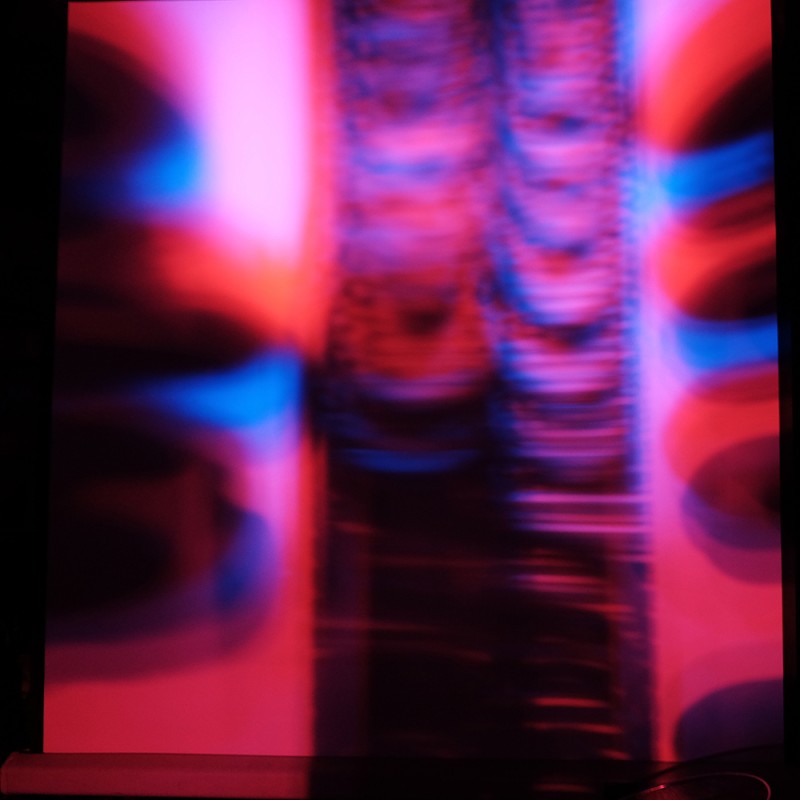
Shadow Signals. 2026
Light, shadows, sound by Isabella Smith
Shadow Signals comes out of the ongoing performance project between Daniel Beban and Tim Barlow, whose DIY experimentations modulate and manipulate light to create sound in a way that embraces magic, coincidence, and failure.
The exhibition, on until the 15th of May, marks the final use of the space before Toi Pōneke closes the doors on Abel Smith Street and heads to their new home on Market Lane by the waterfront.
Inspired by early experiments in light and sound technology and current developments in data transmission, Beban says their approach was to “try it out and see what happens,” rather than taking the “engineered technical” route. He says the things they’re doing are “like some very early failed experiments by Alexander Bell or Leon Theremin, without us having one drop of their technical genius!”
For someone as technologically stunted as I am, what they’re doing, which I’ve been assured is very “simple and primitive”, sounds incredibly complex. Barlow and Beban have created an immersive, interactive experience that is activated only when visitors shine their phone torches through sculptural objects made of collaged-over and painted perspex sheets, in order to create shadow patterns that produce signal music: electronic glitch-scapes, data noise, and shadow tones.
“Different sound frequencies/notes and different rhythms are made by varying the fineness or thickness of the shadow patterns”, Beban says. “The idea that people activate the work is another big focus for both of us... We set up an environment with certain parameters, but it only comes alive when someone interacts with it.”
Glitch as a musical idea and genre grew with the advent of digital technology. It embraces the failure of technology and involves circuit bending, rewiring, and tampering with electronic instruments to create new sounds – a noisescape that Beban, owner and director of Pyramid Club, is more than familiar with. The exhibition experiments with glitch through its celebration of the wonky, noisy, and weird sounds that can emerge out of modulating one energy source into another: the optic into the aural.
The duo first began working together in 2023 for a tribute concert for the legendary artist, sculptor, and light modulator Jim Allen, who designed the coloured glass embellishments in Futuna Chapel in Karori. Barlow says, “There’s an intensity of colour and beauty of reflected light patterns in that space. So we've been trying to turn light into a physical presence that can emotionally affect people.”
An important aspect of their project is working with renewable energy sources. In an earlier evolution of the exhibition, Beban and Barlow worked with sunlight and wind to create sound frequencies, before creating a version that would fit within the enclosed gallery space. Tim Barlow’s art practice focuses on community-based interactive public art, often building concrete sculptures from innovative materials. More recently he has been building seawalls from industrial waste. Daniel Beban has been a central figure in Te Whanganui-a-Tara’s music community. His sound practice explores the sonic possibilities of things, including creating sound sculptures, with many of his works made of found or recycled materials.
For me, the sensitivity of the experiment almost feels like the artists have created their own version of synesthesia, altering our perception by linking two senses together with one setting off the other. Head along and say farewell to Toi Pōneke’s home on Abel Smith Street, and step into your creative duty of bringing this exhibition to life.
View more articles from:
« Issue 266, April 21, 2026