
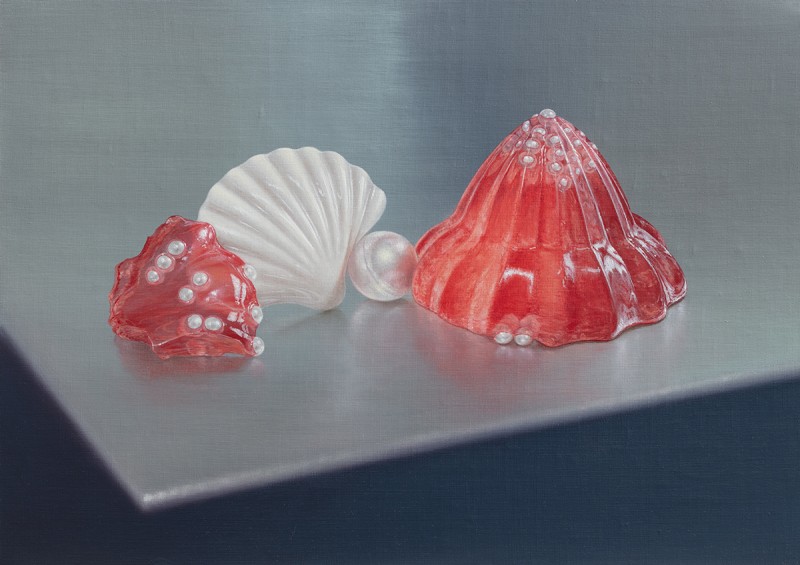
Mind the Pearls by Emily Hartley-Skudder. Image courtesy of the artist
Perfection Salad by Isabella Smith
Harking back to the Jell-O delicacy that was popularised in 1950s America, Perfection Salad refers to the savoury concoction of chopped cabbage, celery, and red peppers suspended in a tart gelatin and shaped by an aspic mold. On until the 16th of May at Jhana Millers Gallery, cross-generational duo Judy Darragh ONZM and Emily Hartley-Skudder explore consumer culture and its plastic excess through their sculptural assemblages and oil paintings, playing with the instability of value hierarchies.
Judy is a stalwart in the Aotearoa art scene. Her brightly coloured sculptures made of found objects call into question consumption and waste while at the same time granting objects a new lease on life through re-arranging and re-evaluating them as art. Strings of brightly coloured plastic line the walls and stand proudly on the floor of the gallery, organised in such a way that they sing in a unified harmony of new meaning.
Emily’s practice too began with working with found objects. At art school she traversed opshops and scavenged through recycling bins to build her collection, all the while looking up to Judy’s work as a resource to grow her own practice. Emily’s oil paintings dial up the absurdity of everyday throw-away items. “There’s ultimately a bit of humour when you challenge the value of things,” she says. “Selling people’s detritus back to them,” or “spending hours and hours rendering a plastic takeaway container in oil paint”.
Emily’s paintings depict brightly coloured Jell-O moulds, cleaning products, and toiletries. Arranged and positioned together on a flat plane reminiscent of traditional still life paintings, she is in conversation with art history and the objects people have revered over time. The objects also evoke a sense of nostalgia for viewers. She says, “There is something simple yet strangely satisfying about taking very ordinary, familiar objects and shifting their context by bringing them into the gallery as art. Combining two seemingly contradictory things always creates a little spark.”
Both Judy and Emily live in the realm of kitsch, “Where objects that were once seen as lower-class nicknacks… have now come to be super collectable items and command high prices.” As avid collectors, the accumulation of found objects shapes their relationships to the wider world: a method of physically collecting ideas. Emily says, “It’s a very fitting way to explore hyper consumerism and the circulation of objects.”
In the same way that the amusing trend of serving Perfection Salad was once considered the height of elegance and a symbol of status, so too are the values of plastic objects in these sculptural assemblages and paintings reimagined. Still lifes that once depicted ornamental fruits now display ornamental cleaning products and kitchenware, and objects destined for landfill have become part of something larger than themselves. “I’d like to think if we can celebrate or treasure some of this plastic then we’ll think twice before it ends up in the trash.”
View more articles from:
« Issue 267, May 5, 2026