
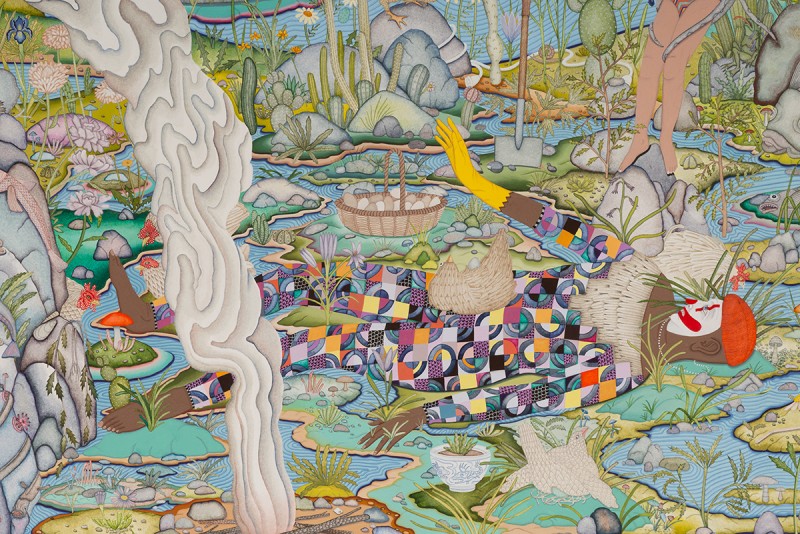
Detail of Consult the Sky, 2023-2026
Pobblebonk by Isabella Smith
Unstable landscapes fold in on themselves, creatures fall over one another in an urgent show of life, anthropomorphic rocks gather in clusters, clowns drift through nature’s carnival.
In her mind’s eye, Ōtepoti artist Kushana Bush has an encyclopedia of images and artistic styles to draw on when making a work, creating large-scale paintings that collapse centuries of art history.
“Often I’m very deliberately chasing an image that encompasses four or five periods and places”, Kushana says. “It’s in the pursuit of this perfect image that I stumble and trip and end up somewhere totally new. My failure is a kind of blessing. What Germans call Glück im Unglück.”
Reminiscent of Mughal paintings, Byzantine iconography, Japanese ukiyo-e prints, and Studio Ghibli, each of Kushana’s paintings is teeming with restless life.
“I think the natural world is extraordinary when you slow down and observe. The pobblebonk frog that sounds like a banjo strum, the petrol iridescence of a tūī feather, the rotund plumpness of a kererū moving vertically in the sky.”
This collapsing of images is a rejection of the idea that art is created to say something specific. “I’m really open to my images being used as a kind of divination. I love the way narrative paintings flex and warp in time. I like how the paintings change according to a viewer’s personal baggage and the cultural milieu around it.”
At once presenting a primeval world still in the throes of organising itself out of chaos, the paintings are highly organised scenes. Kushana is interested in the genre of painting called weltlandschaft or ‘world landscape’, which uses a tri-colour system: the earthen plane (ochres and earthy tones), the living plane (cobalt, teal, and greens), and the celestial plane (soft blues and greys). “The possibility is endless when it comes to colour, even 20 years in, I’m always learning.”
The exhibition Pobblebonk – on display at the Dowse Art Museum until the 28th of March 2027 – comprises works made during two significant periods that closed and opened her imaginative world. The first half of the paintings was created in her bedroom during the pandemic lockdown, where she pictured “what it would be like to be an illuminated manuscript maker in a medieval monastery, nervously painting as the black plague sauntered past the open stone window”. The latter emerged when her daughter was born, and her “tightly controlled world was suddenly upended”.
With less time, she replaced structured planning with intuitive painting, and “the second half of the show organically bloomed like a mould across the paper”.
As her daughter learnt to walk and talk, Kushana’s works too ventured outdoors. “We were playing in sandpits, inspecting clover and holding worms. I was on my knees, down in the dirt, sniffing the clods.”
“I was interested to depict the natural world as grasped for the very first time. Seeing our world afresh, through a child’s eyes, broke the world open again for me.”
View more articles from:
« Issue 279, October 20, 2026