

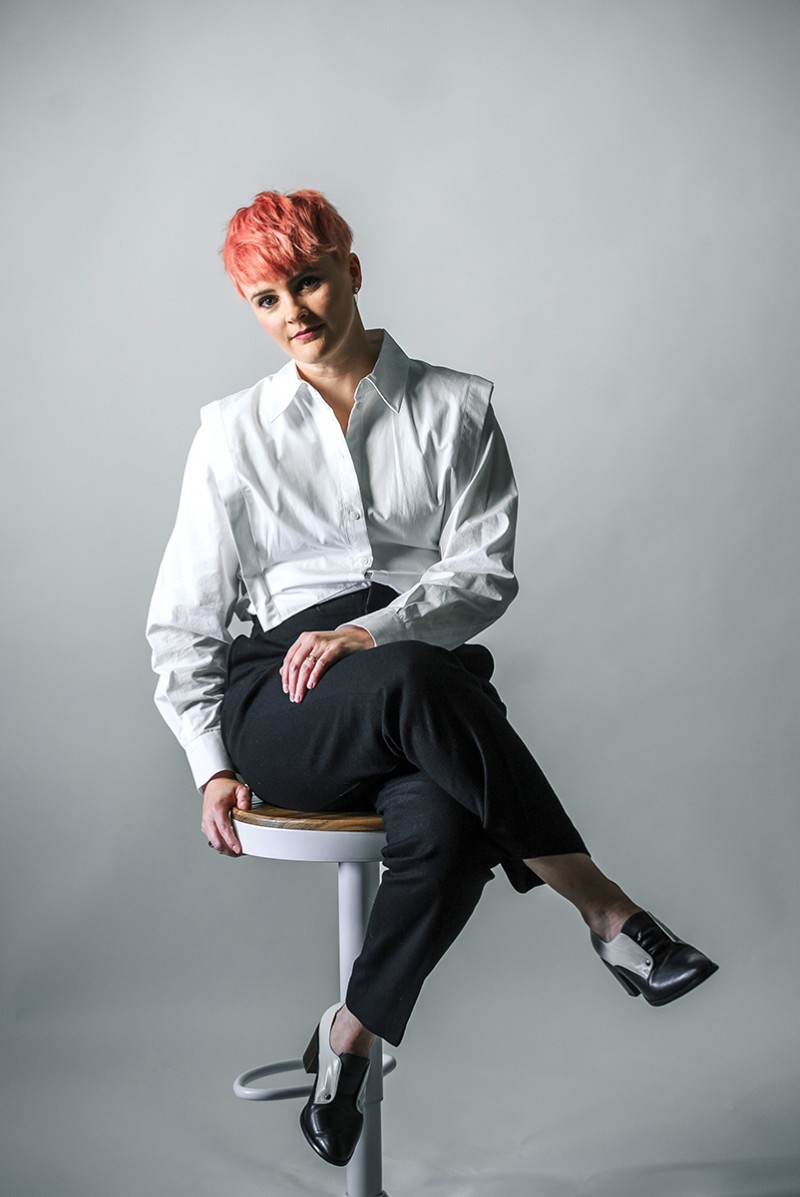
Pushing the boundaries by Madelaine Empson
Claire Cowan is an award-winning contemporary composer whose work traverses film, television, theatre, and dance. In 2019, she became the first woman in Aotearoa and one of only a handful worldwide to score a full-length ballet: Royal New Zealand Ballet’s (RNZB) Hansel and Gretel. She also scored their 2022 production of Cinderella, working alongside her long-time collaborator and RNZB choreographer in residence Loughlan Prior on both new adaptations.
2026 has been a big year for the multi-instrumentalist and Nightflock ensemble leader. Not only did she win the APRA Best Original Music in a Series Award | Tohu Paerangi at the APRA Silver Scroll Awards for her work on the queer crime TV series Bust Up, but she also became the first New Zealander to be invited to take part in the Vancouver International Film Festival’s Composer Filmmaker Accelerator programme (VIFF CFA) in early October. The programme brought together 12 composers from around the world for an intensive week focused on the craft and application of film scoring.
I spoke to Cowan in September ahead of VIFF CFA but while she was still in recovery mode. The week before, she marked yet another first as the artist to record at New Zealand Symphony Orchestra’s (NZSO) Te Ngākau Recording Studios, located in the newly developed Te Whare Whakarauika Wellington Town Hall. Together with the NZSO and a 130-person choir, Cowan recorded her Cinderella score. The soundtrack album will be released in the coming months.
What were the new studios like?
The new studios are absolutely beautiful; world-class technology. The fact that you can record an orchestra upstairs and people in the isolation rooms downstairs at the same time with no lag or issue – that was something that hadn’t been tested at all, and it all worked perfectly.
Can’t wait for the official opening in February! Let’s jump into the VIFF CFA. What was the process of getting accepted?
It’s been quite a quick process. We had to submit a bunch of things: a playlist of our work, tracks that we thought represented our best work, IMDb listings. It was an all-round picture of the composer so they could make a good selection of the best and the ones who would get the most out of the programme. It jointly benefits the filmmakers involved as well as the composers because it’s all about the process of how we work together, so we had to submit examples of that and how we communicate. It was not a usual kind of process: the music’s one thing, but it was also about what we’re interested in doing this job for. What are our reasons for being composers in the film world?
Great question! Hit me.
It’s interesting to ask myself that. Sometimes in the busyness of life, you get caught up in the process and it gets difficult. You get stressed and don’t get much sleep and it’s like, ‘Why am I doing this to myself?’ Ultimately, it’s all about the audience for me, and the connection, and the story. That’s why I do everything: ballets, or playing music, or even creating concert experiences. Being able to elicit emotions, down to the very complicated ones, and putting those at very specific moments in relation to the characters or the storylines. So, connecting!
What’s the difference in the process of composing for film versus ballet?
With a film, usually there’s a picture in front of me and I’ll be writing and responding to what’s on the screen. I may have read a script in advance to get some ideas going or a concept for the sound world. For a film, the music comes in and out and we use it to spice up certain moments or enhance the feelings. The picture does a lot of the job for me.
For a ballet, the process is almost back to front. There’s nothing there to begin with. It’s just a storyline and a spreadsheet of scenes, breakdowns, and approximate timings. The work is kind of harder because I have to imagine what’s happening at the same time as writing. The music does absolutely everything for the emotional and storytelling role in a ballet; there are scenes and characters and acting as well as dancing, but the music really carries it all along. The review process is a little easier for me in the ballet because I present something and then the choreographer works to that, rather than the filmmaker presenting me with something to work to. I feel a bit more in the control seat when I’m writing a ballet, and that’s quite nice.
In terms of imagining what’s happening while writing – when did you discover your gift for realising what’s in your head? Do you hear potential work in your mind’s ear?
Interesting! I don’t think I ever have a fully formed piece in my head and then try and realise it. Things come to me in little clumps of ideas and little bursts of inspiration from different things that I see. I try and expose myself to lots of different artforms for inspiration, like films, or I’ll go to the art gallery to get out of my normal zones. One by one a concept will come together, and I’ll plan it from there. Often I’ll write down with words the kind of piece I’m trying to create, or if it’s a ballet, the musical language. Like with Cinderella, I had a big note in my Apple notes that said, ‘I want the music to be this, this, this; have influence from this, this, this; and emotionally, it’s going to be this, this, this’. I think it’s important to plan those things, but also be open to how things unfold, other people’s influence, collaborations, and happy accidents.
Looking back over your work, what are you the proudest of?
I think Cinderella is one of the works I’m most proud of. It was something we didn’t really want to do, because it’s a dumb story [laughs]. Cinderella doesn’t have a very positive message for the people of today, women or young people! Having been asked to write a Cinderella, we took it upon ourselves to change the story. To make it relevant and positive and inspiring and push the boundaries of what’s been done with ballet before. The impact – what I’ve heard from audience members, and from people in the process of recording the music – is that it’s an important show. Even though it’s fun and upbeat and not altogether serious, it does touch on some things that have very real connections to the lived experiences of people in the audience, and things that they don’t see on stage represented in a national ballet company very often, or just on stage in the dance world. I’m proud of that and hopeful that it can travel to places now that this recording has been done.
View more articles from:
« Issue 279, October 20, 2026