
Photo courtesy of City Gallery Wellington Te Whare Toi
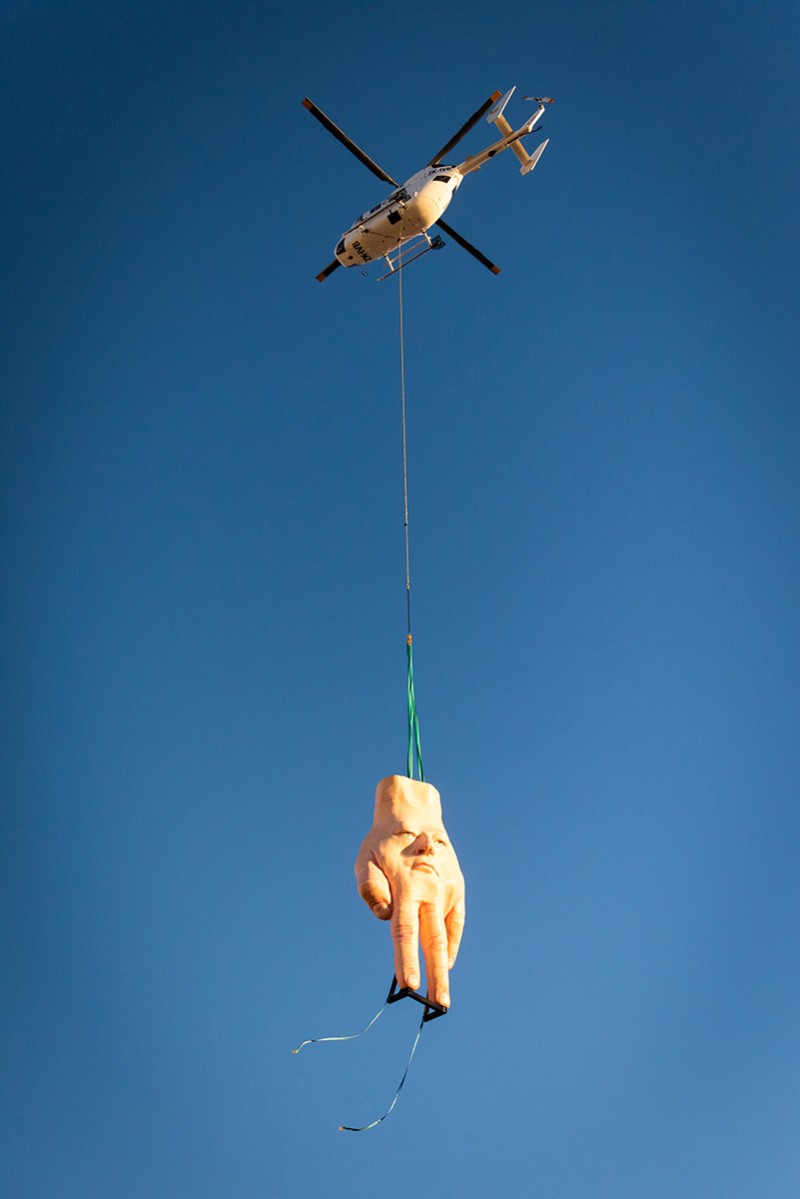
Photo courtesy of Wellington Sculpture Trust
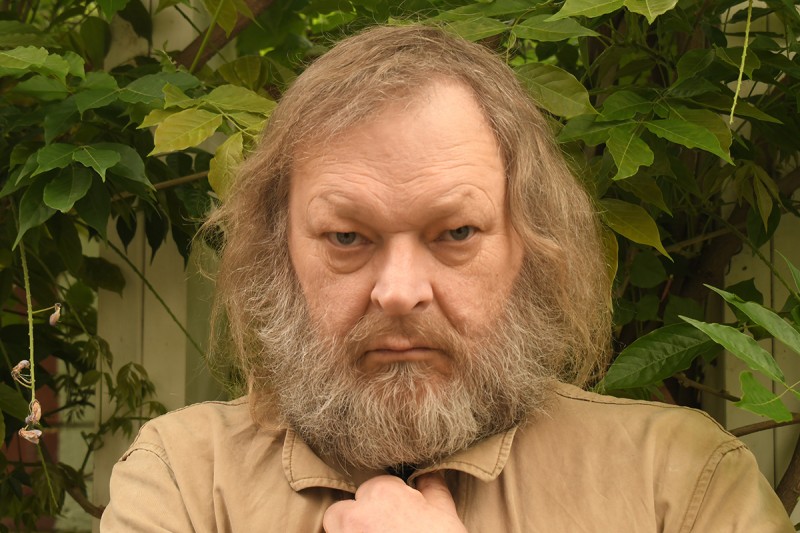
Ronnie van Hout
Quasi by Isabella Smith
In this series, Isabella talks to the artists behind the sculptures dotted around our city.
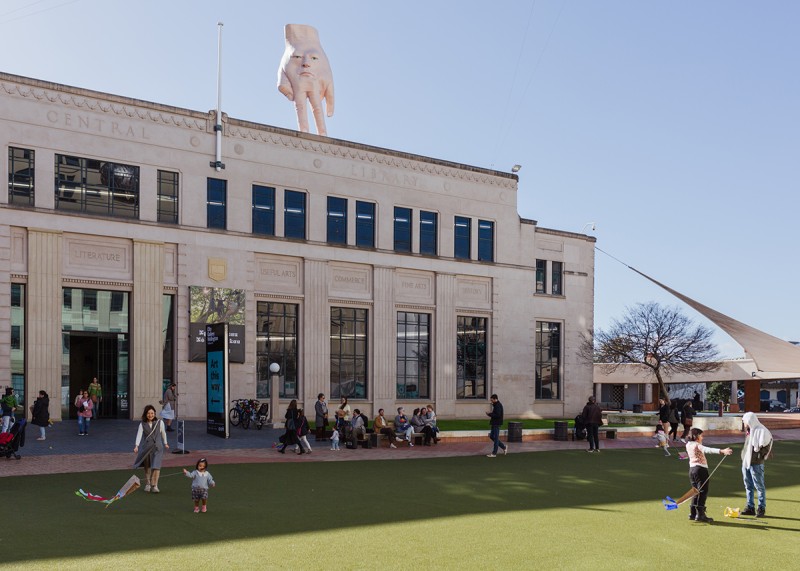
With the reopening of City Gallery Wellington Te Whare Toi after two years closed, it felt like a pertinent moment to recall a tall figure that once stood proudly atop its roof, hand on hip, looking out over Te Ngākau Civic Square the way Batman might’ve done in Gotham or how Quasimodo viewed Paris from the stone galleries and belfries of Notre-Dame.
Ronnie van Hout’s Quasi was originally commissioned as an engaging sign to indicate the Christchurch Art Gallery Te Puna o Waiwhetū was back open after five years closed following earthquake damage. It was then moved to Wellington in 2019 to bring life back to Civic Square, which had suffered as a public space due to closures of the library and town hall.
Standing at five metres tall weighing 400 kilograms, Quasi is a giant, lifelike hybrid face-hand modelled on those of the artist, with a fair complexion, blue eyes, and a rather serious expression.
All public art takes on a life of its own once it is gifted to a city, but stick a human face on it and set it at a distance, and it becomes a participating character.
Ronnie digitally combined 3D models of his hand and face to create the design. The imagery was then used to drive a CNC machine that cut the form out of CNC-routed polystyrene, which was coated in urethane and painted with resin by Ronnie and his brother Francis.
The concept “came out of a video I made using my hands as characters walking on their fingers,” Ronnie says. “The video was made to test out a new video camera, but I ended up liking the reading of the fingers as legs, and hands as bodies.”
“This ability to transfer and transform is a part of art, and I do like illusions where it is difficult to see the two states of an image at once. It’s called the Duck-Rabbit problem, and in this case, it’s the finger-leg problem.”
Born in Ōtautahi and based in Naarm, Melbourne, the multimedia artist’s distinctive style has been described as an existential absurdism that engages with the uncanny. His works are simultaneously humorous and unsettling. The subject is often himself, making mannequins and doll lookalikes that behave as doppelgangers and alter egos.
While he doesn’t inject meaning or assign a theme to his work, he says, “I am interested in the self and how it is created and where it manifests” and that his own hurt and rejection are powerful motivations.
Much can be and has been read into Quasi: an outsider, a superhero, a creep, a monster, a humorous example of boundary-pushing contemporary art. His name comes from the Italian meaning ‘almost’ or ‘not quite’ and perhaps explains the phenomena that he can be all those things, according to who is looking.
In the sculpture’s relation to the fictional character in Victor Hugo’s 1831 novel The Hunchback of Notre-Dame, it is important to note that the name Quasimodo was assigned to the character by the real monster of the story.
“The Hunchback has no name, and Quasimodo is more of a description or category. The point being that when we assign or label something weird, ugly, alien, we are really talking about ourselves. Quasi didn’t put itself outside. Being an outsider or rejected requires someone, a society, a rule, some kind of pressure to reject.”
In 2019, Quasi’s extravagant entrance into Pōneke, drifting over the city one blue sky morning hanging from a helicopter lowline, was a spectacle in itself that immediately invited people to participate in the mythmaking of the new figure who’d come to town.
Like it had already in Christchurch, Quasi’s arrival set the media wheel spinning and saw international publications like CNN, The Guardian, BBC, Time Magazine, and Sydney Morning Herald feature write-ups as well as 35 international media requests for the footage and photos.
Articles spoke of a divided public and polarised opinions. Journalists interviewed passersby and catalogued their responses to the artwork as love or hate; for or against.
A few articles reported public outrage that Quasi had been paid for by ratepayers’ money, despite the transport, Wellington-proofing, and instalment of the sculpture being a joint effort between Wellington Sculpture Trust, Wellington City Gallery, Wellington Community Trust, private backers, and Wellington City Council.
“The history of the media bagging out art is as long as the media itself” and now more than ever it is near impossible to separate myth from art, particularly with the rise of clickbait, which feeds on extreme emotions. Fans of Quasi developed memes, others organised gatherings to ‘bow down to their leader’, there were offerings to knit hand-warmers, and a steady stream of visitors took selfies from Te Ngākau Civic Square.
“The reaction to Quasi was something completely new to me and made me think about how the world and consumption of images had changed,” Ronnie says. “The reaction was mostly constructed by the media and took on its own life.”
You only need look up the sculpture and the artist and a dearth of articles crop up about the controversial character. But the initial intent was for Quasi to draw attention to space, and it “did its job as a sign, as a distraction, and as something to have an opinion on”, with media coverage of Quasi calculated by Wellington City Council to have brought in $1.5 million in free advertising.
“Sometimes the criticisms hurt, especially from the journalists in Christchurch, and I also felt that overall, Quasi has been detrimental to my standing as an artist in the community. People may love it, but people are not the art world.”
In 2024, when Quasi departed Wellington, the sculpture appeared to have been accepted by the city as its own, with the farewells being mostly fond ones.
“I enjoy that Quasi is embraced by so many and feel like it has been taken from my hands,” Ronnie says.
A mirror to society’s own hangups, Quasi has since taken on another epithet: that of the wanderer, like the new kid in school who has to start over again in a new town and establish their place in the pecking order. In 2025, it was installed on the roof of the Henry Jones Hotel in Hobart Tasmania as part of the Dark Mofo Festival and earlier this year, it was moved to stand on the Bendigo Art Gallery in Victoria, where it will hopefully remain until 2028 – though flocks of corellas, a type of cockatoo, have taken a liking to the sculpture, picking at it and causing superficial damage.
When I ask about lessons from Quasi, Ronnie tells me, “I guess what I have learnt from Quasi is that people want to belong, be accepted by others, and be loved. As a consequence, the majority of people just try to fit in. The self is a reflection of how others see us, not some inherent quality of authenticity.”
“Public art has a range of roles to play. It is a genre of art, that many would argue is not art at all,” Ronnie says.
“There is an interest in making public art more interactive and meaningful, because we want things to be utilitarian. It is a thing in the world that is often in relation to architecture; that is not architecture, that is not furniture, or a playground, an advertisement, but could be these as well. Something to look at that makes you say, ‘What the f*** is that?’ or ‘How much did that cost?’ or ‘That’s cool’ or ‘Whatever.’”
View more articles from:
« Issue 279, October 20, 2026