

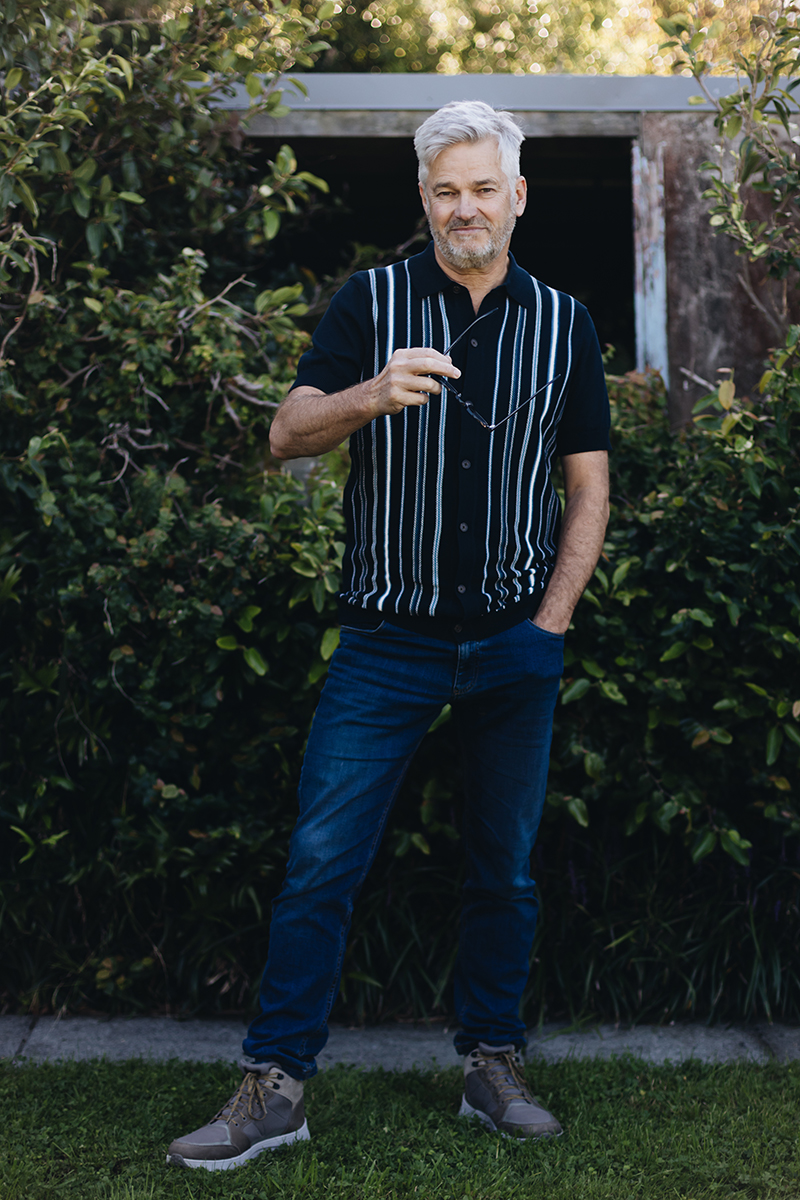
Photo by Bonny Beattie
Rock band redemption by Isabella Smith
Paper Husbands is Nick Sceats’ debut novel published by The Cuba Press. It’s the 90s here in Wellington, and the band of the same name are trying to make it on the music scene. After a song gets put on high rotation on student radio, they get the once-in-a-lifetime opportunity to open for UK legends Shimmer. The sudden disappearance of the frontman Pete before the show shatters those dreams. Fast forward three decades, Bob the drummer runs into Pete at San Fran, and a casual catch up leads to them saying: let’s get the band back together.
This impressive debut, described by Flying Nun Records founder Roger Shepherd as “A fine work of rock band redemption”, features lyrics and QR codes that link readers to the album Beautiful Edges, which Nick and his band created featuring the songs mentioned in the book. We caught up to discuss the book, the process of writing it, and the ideas behind the album.
How would you introduce yourself as a writer?
I suppose as a novel writer – it’s my first novel, but I’ve always written. I started life off as a journalist, and I’ve always written songs. I love singer-songwriters who can write a story in three verses or three minutes like Paul Simon or Paul Kelly. I thought, if I can write a story in three and a half minutes, then I can have a go at expanding it out wider to become a novel. When you’re writing a song, you have to move the action along quite quickly. The book does move along at a trot – it is tight and crisp, and I think that’s a function of songwriting.
Did the idea of the book emerge through playing in bands of your own?
The initial idea, yes. I was in a band in the late 80s, early 90s in Wellington. We didn’t really have any ambition; we were just good mates who liked to play together. We did play at the Clarendon, which is referenced in the book.
But it could equally have been a bunch of guys who go tramping or surfing together, who have unfinished business. It just happened to be a band, because that’s the kind of group that I was most involved in at that time. I knew the dynamic of a band, the banter, and what goes on in the practice room.
Did you write your way through, or are you someone who plans it out?
No, it really wrote itself at its own momentum. I remember getting stuck and walking along the beach with the dog, and ideas would come to me. I just let it evolve freely, which was half the fun.
It’s a lovely state of mind to be in when you’re writing.
People talk about the ability to play God. You say, ‘You know what, I might send a couple of these guys over to the UK.’ You don’t have to pay airfares; there’s no need to worry about anything. You just make it up. It was such fun to have that kind of power and agency.
I enjoyed the editing process as well. You think you’ve finished something, then the publishers say, ‘Hey, I think you should do this or lose that or consider this.’ It helps with your brushstroke. After all that editing you stand back and see a much more vivid picture. I don’t think every author enjoys that process. But I’m old enough now that my identity is not attached to the work.
Do you think being in journalism had something to do with that detachment?
Not really, I wasn’t a journalist for a long time. I co-founded a leadership development company, and a lot of what we do is teach leaders the ability to be coachable, to take feedback. I relate it to being eminently coachable on every aspect. I was just like, ‘Bring it on, you’re going to get no resistance here.’
Did that result in any drastic or surprising changes?
I got rid of a character and a couple of scenes that were funny but didn’t necessarily move the action on. My mantra was always to do what serves the story. It’s the same when you’re writing and arranging a song, what serves the song?
What came first, the album or the book?
The book. One of the songs we recorded was from the band I had back in the 80s, 90s. I had a couple of others that I’d been working on, but none of those related to the plot so I wrote new ones.
The songwriting and novel writing very much informed each other. There’s one song called Rear Vision Hearts, which is about one of the characters trying to support his wife who’s grieving the loss of their children leaving home. They’ve left and she’s kind of stuck in the past. He’s trying to be supportive and bring her forward. The song captures that much more emotively than if it was just a narrative in the book. It gives you a different, much more moving perspective on it. The hope was that the songs would supplement and give a different kind of angle to the characters.
Another song, Repo Man, is about one character’s father having dementia. They call it Tenacious D. I wrote the song specifically for that part and new ideas came out of writing it, which then fed back into the narrative.
Did you record everything yourself or did you get a band together?
The guy on the drums, Tim Robinson, played in the band I was in back in the 80s. I’ve played in other bands with him over the last 40 years as well. Then Murray Costello was the bass player, I’ve played with him off and on for years. They’re a fantastic rhythm section. Then my son Reuben produced the album and played all the hard guitar parts, he’s a fantastic guitarist. He sang on four of the songs as well. It was so wonderful doing it with him, having him produce these four old fellas.
Then the keyboard player, Lee Pryor, I’d never met him before, but I got in touch with him and he came in for the last two days of recording and put the keys on.
We recorded it in about six days at The Surgery with Lee Prebble. My other son Max is an artist and he did the cover art. It was pretty neat to be able to do a project and have both my kids adding their artistic value to it.
Sounds like you had a lot of fun!
Yeah, I really did want to have a book that was positive and plot-driven about friendship between decent, well-functioning men, not numpties or renegade loners – which is often how they’re portrayed.
I love reading and I know so many men who don’t read, and to me that seems so sad. I think a lot of the time they don’t read because they want it to be more pacey, or they don’t see themselves reflected. I thought it’d be nice to write a book where men of a certain demographic get to see themselves. I wanted something that was fun too, because there’s enough misery in the world.
It’s sad how that has happened – less men writing, less men reading.
I had really good feedback from people in my football team and the sailing club who’ve read it. The fact that they read it all the way through... To me, that’s a win. To me, that’s success. It’s not just for men, obviously, but I think, if guys are reading it and enjoying it, then I’m a happy man.
View more articles from:
« Issue 271, June 30, 2026