

The Ground Will Not Hold
Photo by Stephen A'Court.
The Ground Will Not Hold by Isabella Smith
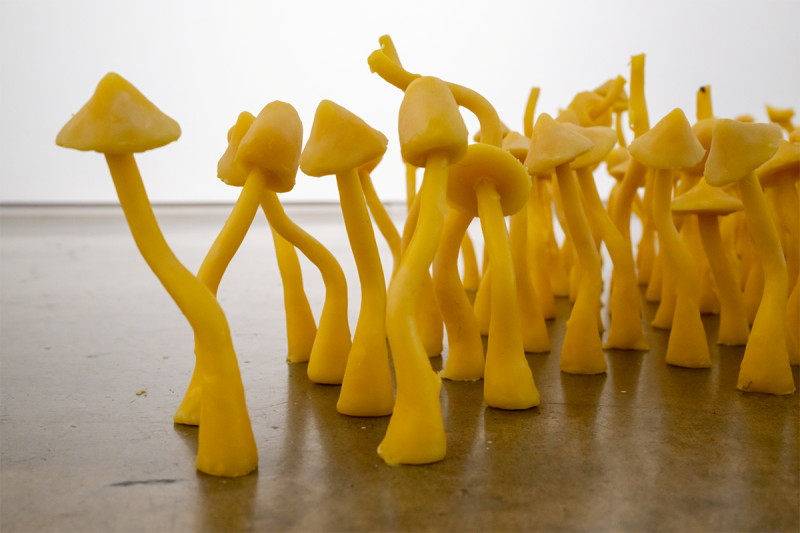
At the heart of Bowen Galleries lies the remnants of a ritual. A constellation of mushroom-shaped handmade beeswax candles stands twisted and charred in the shape of Aotearoa. On the walls, photographs preserve a fleeting moment where these same candles once formed the New Zealand flag, whose Union Jack and Southern Cross are formed in flames.
The Ground Will Not Hold is transdisciplinary artist George Turner’s latest exhibition. On at Bowen Galleries until the 15th of August, it brings together a year of studio research into contemporary land use in Aotearoa.
A series of oil paintings depicting young, geometric pine forests lie west of the ritual, titled ‘To the Greatest Extent Practicable’ after the vague legal phrasing used in the Conservation Amendment Bill that seeks to open conservation land to economic development. Fungus-like platforms made of wind-felled pine protrude out of them, each holding a single unlit candle.
George’s art resides within a state of tension. “I’m interested in materials and symbols that refuse to stay in one place,” they say. “Fire can be destructive, but it is also warmth, memory, transformation, or offering. A candle not lit still holds the possibility of fire.”
“Beeswax is natural and beautiful, but it also carries ecological fragility... A mushroom can suggest decay, but also survival and transformation. For me, the works sit in that unsettled space where something can be beautiful and damaged at the same time. That feels honest to how I experience the whenua.”
George’s work often interrogates Pākehā identity, post-humanism, ecological instability, and colonial inheritance. The Ground Will Not Hold confronts the fantasy of clean, green, wild New Zealand, and the Pākehā identity formed out of this selective idea. “In Aotearoa, I think we often imagine nature as something limitless, a kind of endless green backdrop to our national identity. But that image doesn’t hold.”
The exhibition title nods to a line in The Second Coming, an apocalyptic poem written by Yeats in the wake of global devastation from WWI. “I wanted to bring it down into the ground itself,” George says. The exhibition “is about the failure of the structures we place on top of land: national symbols, property, plantations, laws, myths of wilderness, even ideas of home. So, when I say the ground will not hold, I don’t mean one dramatic collapse. I mean the slow failure of a national fantasy.”
Further tension lies in the materials themselves. “Wax melts and changes; photography fixes and preserves,” they say. “One is stable, the other pretends to be stable. But both are fragile in their own way.”
A pair of photographs titled National Heat immortalise candles burning as though in a vacuum, grounded only by the reflection of the glowing flames beneath where they stand, the same way in which inner conflicts of identity and nationhood are mirrored in the monoculture pine forests that imitate wilderness.
“Our rivers, forests, coasts, national parks, and conservation areas are all shaped by histories of colonisation, extraction, introduced species, and ongoing human intervention… The ground breaks when the stories we have used to stabilise ourselves stop working. What comes after that is uncertain.”
View more articles from:
« Issue 274, August 11, 2026