

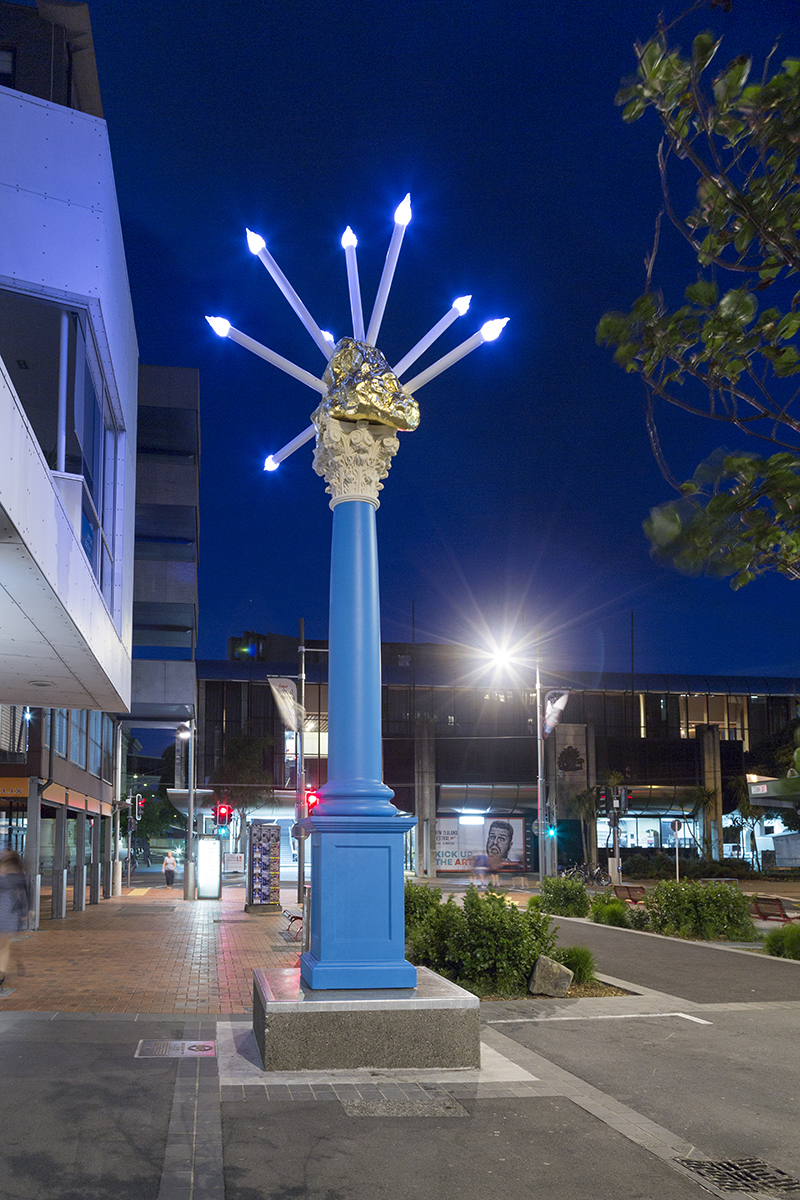
Photo courtesy of the Wellington Sculpture Trust
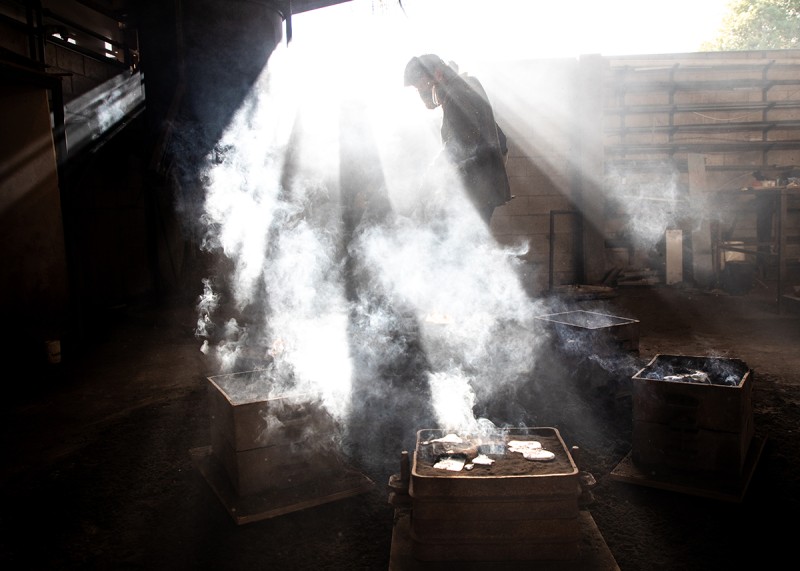
Scott Eady pouring aluminium
Photo by Thomas Lord
The Philanthropist’s Stone by Isabella Smith
In this new series, Isabella Smith talks to the artists behind the sculptures dotted around our city.
Scott Eady is known for disruptive and troublesome sculptures. They complicate, subvert, frustrate, appear in strange places, unsettle histories, and probe at the tense relationships between people and public art, always with an element of humour. The Philanthropist’s Stone is no different. A mishmash of objects and materials, it operates at multiple levels to question history, commemorate the generosity of a Wellington philanthropist, and encourage play.
The Philanthropist’s Stone sits at six metres tall and looks like a child might have picked up each element and assembled them together with glue, while at the same time looking balanced and elegant. Standing atop a plinth featuring grind rails for skaters and places to sit for pedestrians, it consists of a bright sky-blue Corinthian column crowned by a lumpy gold nugget skewered with several glass-blown candles that stick out at funny angles. At night they light up lower Cuba Street like some proud, botched Lady Liberty.
Like any good art, it sparked intense debate at the time of its unveiling. Like any good arc in the life of a public work, it has since come to be loved by the city. “Artists develop a thick skin early in their careers,” Scott says. “If we didn’t, we wouldn’t keep making this stuff called art. Art sometimes pushes boundaries and buttons. If an artwork generates robust and passionate discussion, then it’s doing something.”
At the time of its creation, Scott was involving his children in his creative practice. Giving them Du-kit clay, they created lumpy mini-sculptures that he scaled up, cast in bronze, and finished with a high-gloss paint. These forms made their way into various spaces, including the 2013 Venice Biennale, with one appearing half buried outside the Wellington City Art Gallery as though it had dropped heavily from the sky.
“Public sculpture carries an enormous responsibility and almost always depends on the expertise of others. Engineers, foundries, fabricators, and installers all contribute to and shape the final work. Some of those collaborators become lifelong friends,” Scott says. “The sculpture’s various parts were built mostly in New Zealand by a colourful cast of skilled craftspeople from Dunedin, Ōamaru, Christchurch, and Wellington. The plinth, column, capital, bronze blob, and the stainless steel and glass candles all came together for the first time during the installation in Wellington.”
Some have described the golden lump as a piece of chewing gum or something much ruder. Really, the gold leaf-covered blob (accidentally) pays homage to the goldmining prospects that first brought Thomas George Macarthy over from England to eventually become a prominent businessman and, ultimately, one of the most generous philanthropists for the Greater Wellington Region.
The stylised, hand-built capital atop the Corinthian column too marks the Victorian age in which Macarthy built his expansive business portfolio, while the glass-blown candles playfully mark the centenary of the TG Macarthy Trust – established on his death in 1912 – for which the sculpture was originally commissioned by the Wellington Sculpture Trust and Public Trust.
Very few people know Thomas George Macarthy, “yet it is likely that everyone in the Wellington region has benefited from this man’s generosity without knowing it,” the then chief executive of the Public Trust Graeme Hansen said following the unveiling of The Philanthropist’s Stone in 2015.
Enticed by the promise of gold, Macarthy left his home, first for the goldfields in Victoria, Australia, and then for Otago in the 1860s. He acquired a brewery in the goldmining town of Charleston on the West Coast, before shifting to Wellington in 1877 where he purchased a brewery on Customhouse Quay, followed by a larger one on Tory Street. He acquired hotels and urban property and had other successful business ventures, including the Wellington and Manawatū Railway Company, the building of the Wellington Opera House, and as director of the Bank of New Zealand. A public figure, the governors of the TG Macarthy Trust after his death included and include to this day the Prime Minister, the Catholic Archbishop of Wellington, the Governor, and Wellington's Mayor. For anyone following this series, the best man at his wedding was ‘Father of Wellington’ John Plimmer, whose warehouse Plimmer’s Ark inspired Glen Hayward’s sculpture The Grove located on the waterfront and discussed in issue 272.
The TG Macarthy Trust is one of the largest perpetual trusts in Aotearoa. Since it was established, it has distributed over $85 million, with $2-3 million dispersed annually to various non-profit organisations that help improve the quality of life for the disadvantaged and marginalised, help young people develop and realise their potential, look after and provide dignity for older people, and provide essential medical and emergency services. Just last year, the trust donated $3 million to 700 education and community groups across the Greater Wellington Region including 206 schools, 57 play centres, 149 kindergartens, 73 kōhanga reo, nine Pasifika early childhood centres, 28 toy libraries, and 176 charities.
“I think the TG Macarthy Trust, The Sculpture Trust, and the selection committee were very brave. Perhaps they knew [The Philanthropist’s Stone] would divide opinion, just as the [TG Macarthy] Trust has always been prepared to stand alongside people who are too often overlooked,” Scott says. “It’s great when a city does embrace a sense of ownership even if the artwork remains polarising. Wellington is well practised at this thanks to the Wellington Sculpture Trust.”
The sculpture provokes discussion, looks at colonial history, provides seating, gives skaters grind rails, and lights the street at night. But ultimately, it invites a sense of play. Even the title riffs off the first Harry Potter book, as it “ties together the ideas of generosity, transformation, and value.”
“Sculpture occupies space, so it commands attention. Good public art can take many forms. It can be beautiful or ugly, reflective, or playful. It can question our prejudices, connect deeply with the history of a place, or quietly become part of everyday life. Sometimes it does none of those things – and that's okay too.”
View more articles from:
« Issue 274, August 11, 2026