

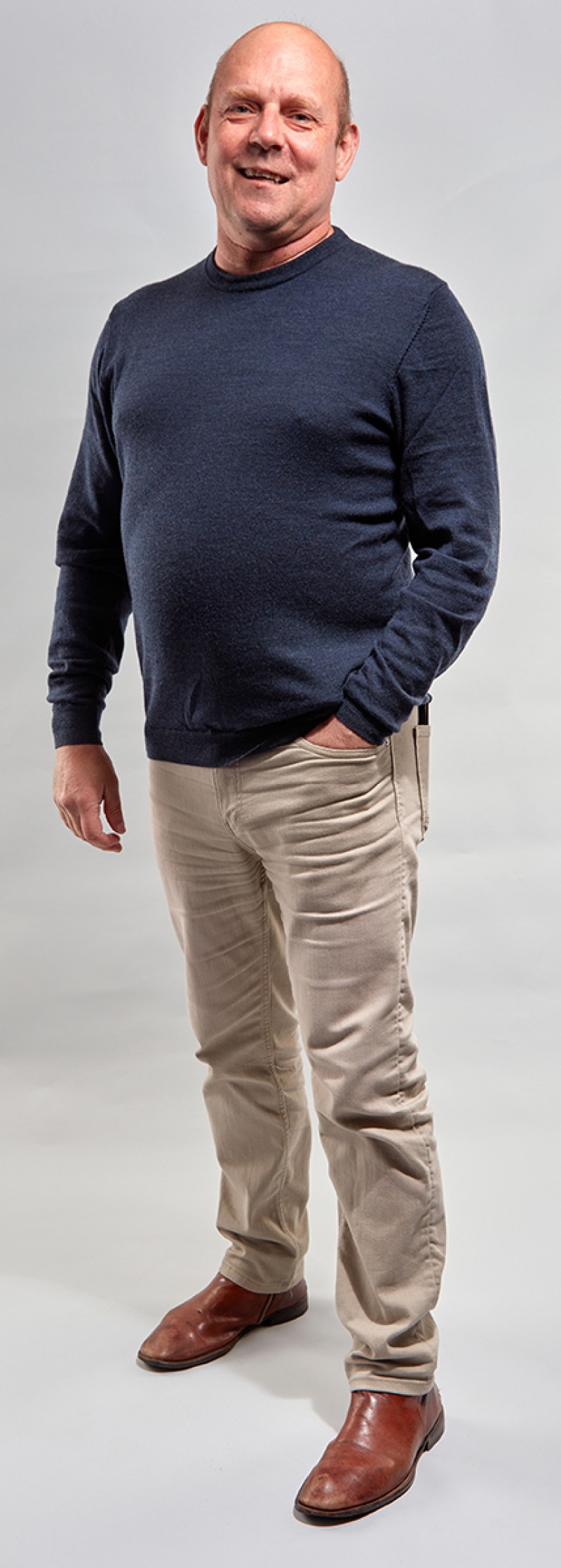
Photo by Andrew Empson
The work-art balance by Madelaine Empson
Oliver Mander grew up on a diet of school productions in Christchurch and moved to Wellington in 1994. After a long break from theatre due to a role with BP that took him around the world for two decades, and prioritising raising his children, he made his return to acting in Wellington Repertory Theatre’s Take A Chance On Me, directed by Ewen Coleman in 2015.
Since then, he has become a well-known face on our stages and behind the curtains, working with local companies like Porirua Little Theatre, KAT Theatre, Stagecraft, and, of course, Wellington Repertory Theatre, where he served as president and later treasurer for close to a decade. In 2025, Mander made the difficult decision to step away from the board due to increasing job intensity. He may be the CEO of NZ Shareholders’ Association, but that has by no means stopped him getting involved in the Pōneke community theatre scene.
Mander will direct the first production of Wellington Repertory Theatre’s centenary season: Ben Elton’s Gasping, which boldly envisions a world in which consumers must pay for air. Catch it at Gryphon Theatre from the 18th to the 28th of March, and catch Mander’s musings on the show below as he looks back on his time with the theatre company so far.
What sparked your interest in theatre?
When I was at school years and years ago, I was quite shy, to say the least. I discovered when I was on stage in an acting role, I lost my stutter. Acting helped me become someone else, and therefore my own personal shortcoming – the way I spoke – didn’t really matter. Eventually, acting became reality and over time that’s morphed into just talking normally. So, it was a very helpful tool.
What kept you involved with the Wellington Repertory Theatre board from 2016 to 2025?
The ability to help shape an organisation that could last, that could push itself in different directions, that could have an expanded programme, and that could offer challenges to people. I always enjoy working behind the scenes on things as much as I do in front of things. In fact, it’s almost a preferred mode.
Looking back over the last decade with Wellington Repertory Theatre, what shows most jump out at you?
Some of the large-cast shows were really powerful. Some of the lesser-known shows – Our Country’s Good, directed by Joanne Lisik in 2016. Shakespeare in Love last year was a bit of a highlight, it was the first time it’d ever been staged in New Zealand. It involved a huge amount of people from a lot of different walks and backgrounds. It’s always good to see how cast and crew bond during the show – it all comes down to the culture that forms around each one. There have been shows where that culture has maintained itself for a really long time. Most recently, The Great Gatsby was an example of that. The people involved have kept the faith.
I really enjoyed staging Popcorn by Ben Elton, which I co-directed with Isaac Borgman. We did it a little differently – used AV extensively to form an inner monologue of what was going on in the show. People either loved it or hated it, but it didn’t matter because the quality of acting and the production values were really high. I think Wellington Rep’s ability to take a bit of a chance, a bit of a risk, do things that wee bit differently, by and large that really creates a different style and a different portfolio of shows for audiences. Wellington Repertory will take on projects that no one else does, from a community theatre perspective. I think that means it’s always fresh and always interesting. It does come at things from different perspectives. That’s a key strength.
Can you pinpoint the most outrageous thing that’s happened on stage?
Nothing outrageous ever happens on stage [laughs]. Sometimes it’s when the audience doesn’t realise anything’s going wrong – happy days! There was one show, Brassed Off, that I was in with my son. That involved a lot of running around backstage changing costumes. I remember going on stage and I hadn’t had time to do my pants up properly, so basically I just sat there, facing the audience, shifting my muscles around my hips to make sure they didn’t fall down.
The stuff of nightmares!
It wasn’t good [laughs]. There are more, probably better stories than that, but it certainly springs to mind…
Like you say, when the audience can’t tell that things are going wrong – that must be testament to the cast’s dynamics and chemistry that they can keep things going?
It’s actually where the culture of the show really matters, and where that bonding becomes important – that’s absolutely right.
Speaking of culture! How are rehearsals going for Gasping?
It’s a great, strong cast and they’ve bonded really well, which allows for a flexible rehearsal process. Rehearsals are good. We started early, which was a great decision. We’re now able to spend more time on the characters and the trickier bits in the show. To me the really big thing is pace, particularly when you’re dealing with Ben Elton. His writing is like his comedy: it’s fast-paced, it’s action-oriented, it’s coming at you the whole time. You can’t afford to take a pause in that.
You’ve managed to maintain the work-art balance – any tips and tricks? What would you like to see more of in Wellington to make the juggling act manageable?
Having an open mind is a really big thing. I’m not particularly dictatorial, so recognising when you haven’t always got the right answer. Having two people is always better than one. When things do need to change, working around that – so building a much more flexible approach. It’s just a fact that we all lead busy lives. [With Gasping,] we’ve tried to keep a flexible and fluid rehearsal process to make sure we meet everyone’s needs. And flexibility in an employment relationship is undervalued, but it’s really important and can and should be recognised.
For community theatre, we do this for fun, we’re not paid for it. Whether you’re onstage, you’re the lighting designer, or you’re me trying to direct something, we do it because we love it. That’s it. So, it’s got to be fun. For everything else, that has to be the ethos, in terms of the culture that you’re trying to build.
Directing for the love of it, what are you getting out of Gasping, and what do you hope your audience gets out of seeing it?
Gasping is a classic Ben Elton show. It’s full of satire and it’s a comedy with a fairly overt message. In this case, it’s lampooning and skewering corporate excess. There is a bit of a connection between what I do in my professional role and the play. In my professional role, I’m encouraging the voice of the little guy: advocating for small shareholders, and encouraging great corporate governance and corporate disclosure transparency in New Zealand. Bit of buzzword bingo there! But actually, what Gasping is all about is exactly that. It’s about what happens when a corporation is not transparent. It’s the exact opposite of the things that I advocate for and the things I promote in real life: the antithesis of how I’d expect a good corporate to behave. Maybe that helps form the relationship in terms of highlighting the viciousness of Lockheart Holdings – the protagonist of the play.
I think what the audience will see onstage is a great production that shows us what happens when there’s no balance: when the excess only goes one way. It’s a great show with lots of themes to unpick: a black comedy, a really good night out, a good laugh, but with a message, as Ben Elton always has.
View more articles from:
« Issue 263, March 10, 2026