

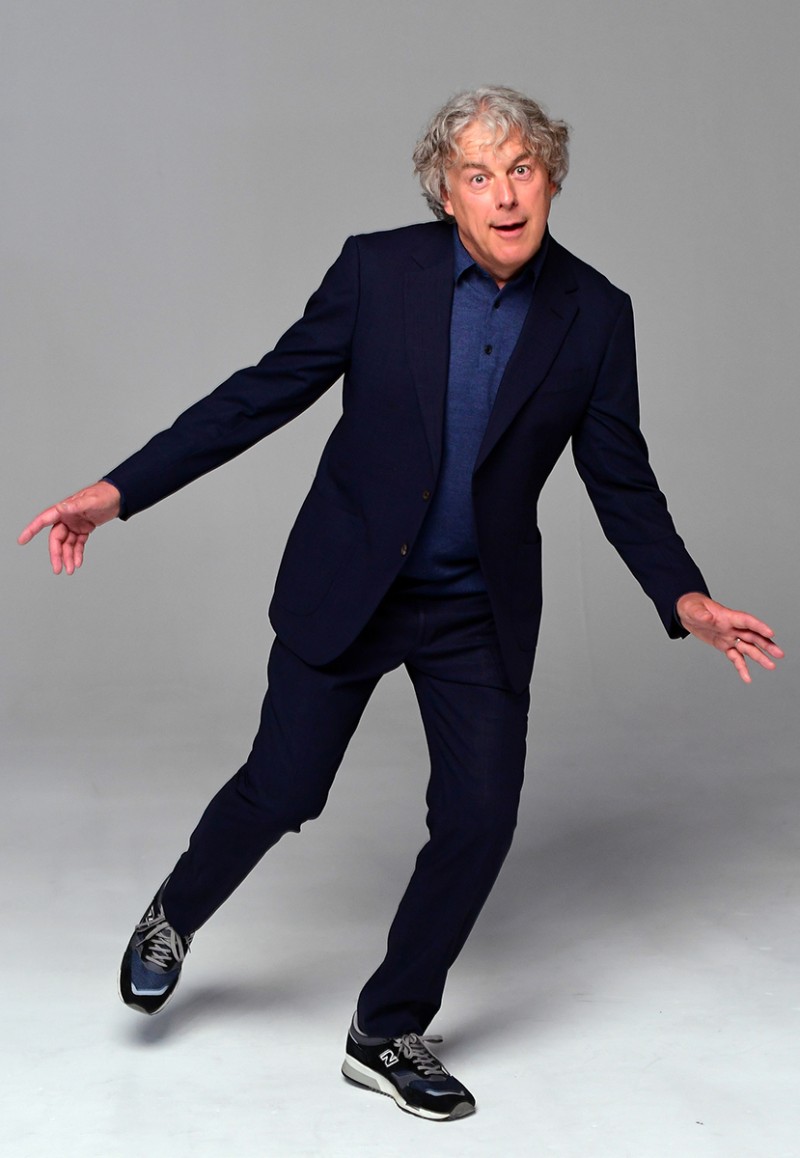
Photo by Tony Briggs
Thinking ahead with Alan Davies by Madelaine Empson
“One of the best stand-up comics out there” (The Guardian) is in the midst of his first tour in a decade. Think Ahead sees critically acclaimed comedian, actor, writer, and TV personality Alan Davies thinking he’s Marty McFly but older than Doc Brown and funnier than ever, he says – and that’s saying something!
Davies is known for his performance as the eponymous hero of the hugely popular, long-running TV series Jonathan Creek and as a permanent panellist on QI, the BBC Two British comedy panel quiz show in which comedy stars swap funny facts on every subject under the sun. Hosted by Stephen Fry from 2003 until Sandi Toksvig took over in 2016, Davies describes the atmosphere of the show as infectious.
“Always, behind the scenes, there’s a team of researchers and producers who have just spent three or four months researching material, finding the QI angle on subjects”, he describes as a key to the show’s success. “My job, and the job of the other comedians who come on as guests, we don’t know what the script is going to say, we don’t know what the questions are going to be… We’ve got to get some sort of ball in the air, keep it bouncing around between us, improvise, collaborate, work together, and be jolly about it”, he laughs.
Read on as Davies and I Think Ahead to August, when he’ll pull up to pull no punches at Michael Fowler Centre on Saturday the 8th at 7:30pm.
What do you remember about your first comedy gig in 1988?
I was a student at the time, and I was living in a little town called Whitstable, which is in Kent on the coast. It was quite cold on that coastline. There wasn’t a lot to do in that town, but there was a place called the Labour Club where students went for a Friday, Saturday night. Some of my friends were in a band, and they knew I was talking about comedy a lot, and they put my name on the poster and said, ‘Why don’t you do it? But if you haven’t got anything, just introduce the bands.’ So I worked out a set, and everybody in the room, pretty much, I knew. So that in a way made it worse, for them I think [chuckles]. But it went well. It was thrilling, it was extremely nerve-wracking, my hands were shaking I remember. That carried on for several months of doing stand-up in my early twenties – the nerves. I overcame that, and it became an obsession. I did stand-up nonstop for years. Then I started to get into television, and that took me away from it. There was quite a long period when I wasn’t doing it at all, and I realised in hindsight, it’s quite bad for my mental health to not have that outlet, that place to express myself. I think I am in a much better place when I’m gigging regularly.
I was going to ask why you chose comedy and where you think its power lies – it seems like it’s very important to you personally.
Well, I love comedy, and I loved comedy shows as a kid, sitcoms I grew up with – they were probably shown on New Zealand television as well, shows like The Good Life, Fawlty Towers, Porridge. When I got into comedy, it gave me a real feeling of confidence. I like the lifestyle; it wasn’t like having a job. I made money quite quickly compared to a lot of my peers who had left university at the same time. I immediately felt quite good about myself and liked what I was doing, the people I was meeting. I’m turning 60 soon and quite a few of the people coming to the party are people I met in the late 80s, early 90s on the comedy circuit. So, it’s a very important part of my life.
The new show that I’ve got is working really well. I think in a way, it’s taken me this long to really talk about all aspects of my life. I went through some quite difficult things when I was a kid, and I weave those stories in and create a fuller picture of who I am and what I think and what I’ve been through. There was a while, I think, when I was putting a bit of a front up, which is quite common in performance: public face, private life. Now I think it’s a more complete picture and it’s a better show for it.
In weaving in those stories, is it like comedy helps you to process the past?
Yeah. I wrote a memoir called Just Ignore Him, which was published in 2020 and which was really about my childhood – about my mum dying and my father, who abused me as a kid. That book finishes as I started going into stand-up comedy. Now there’s a new volume called White Male Stand-up [2025]. It’s about that process of going into a comedy career and then what became a television career carrying all of this stuff, and imagining that I’d left it all behind – because if the future is ahead of you then you leave the past behind, which is, of course, a very naïve view of how life works. It was actually a harder book to write, but it was in the writing that I began to access some of the ideas for a comedy show, which is a different muscle. It’s a different part of the brain almost. Because the story is then told to an audience, how the story is formed, how it’s shaped, is worked out in relation with an audience in the room – it’s very different to sitting at a keyboard. But it’s drawn from the same place in life that I’d reached when I was writing the book and coming up with the show.
You get that immediacy of feedback with the audience in the room as well, that electricity.
That’s exactly it. And you soon find out if you’re approaching the subject matter in the right way or the wrong way. Managing where the laughs are going to be, where you need it to quiet down, where you need silence for a moment to make a point and then bring it back around. I’ve tried to make the show as funny as I possibly can, that’s always been my first aim doing stand-up.
The Think Ahead tour began in 2025. How are you finding life on the road this time?
I did a lot of shows last year, about 50. I was really tired [chuckles]. I’m nearly 60 and I’m finding it much more tiring than it used to be! But that’s life and I like going to places, I like getting off trains in railway stations or pulling up in theatres. It’s nice. I’m pleased to come to New Zealand with a show that works and is all running and ready to go. It’ll be a good tour.
What are your memories of our wee corner of the world?
I’m very fond of the place, which is why I keep coming back. I’ve been fortunate to have had some holiday time in New Zealand, driving round the South Island – so beautiful there. And also travelling all over seeing lots of towns, talking to lots of audiences, I always enjoy it.
If the audience could take away one thing from the show, what would you want it to be?
A copy of my book [laughs]. I’ll probably be signing them in the foyer afterwards! No, I hope they go away thinking, ‘I haven’t laughed like that for ages’. I’d like people to come out to the theatre and get together – that’s what they’ve been doing for thousands of years. People haven’t spent thousands of years on their phones, doomscrolling the internet. It’s not good! So, for a couple of hours: phone off, face the front, I’ll do the talking and you’ll be fine [laughs].
View more articles from:
« Issue 261, February 10, 2026