

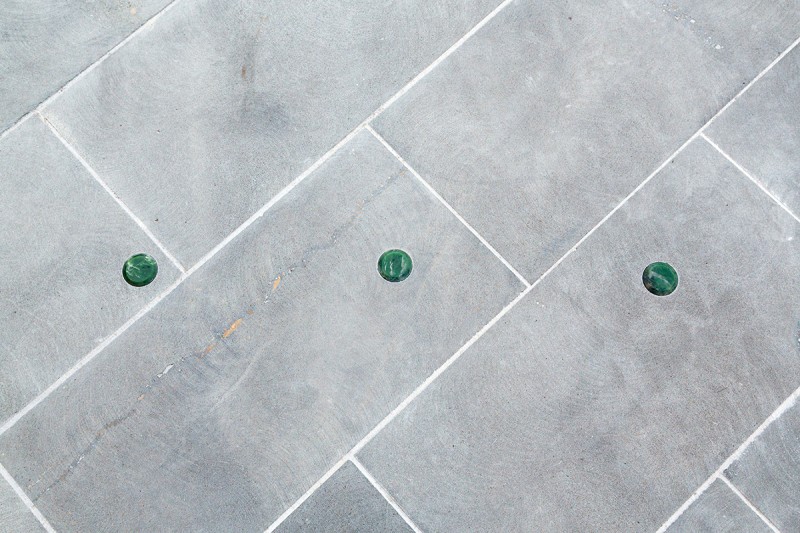
Photo courtesy of the Wellington Sculpture Trust
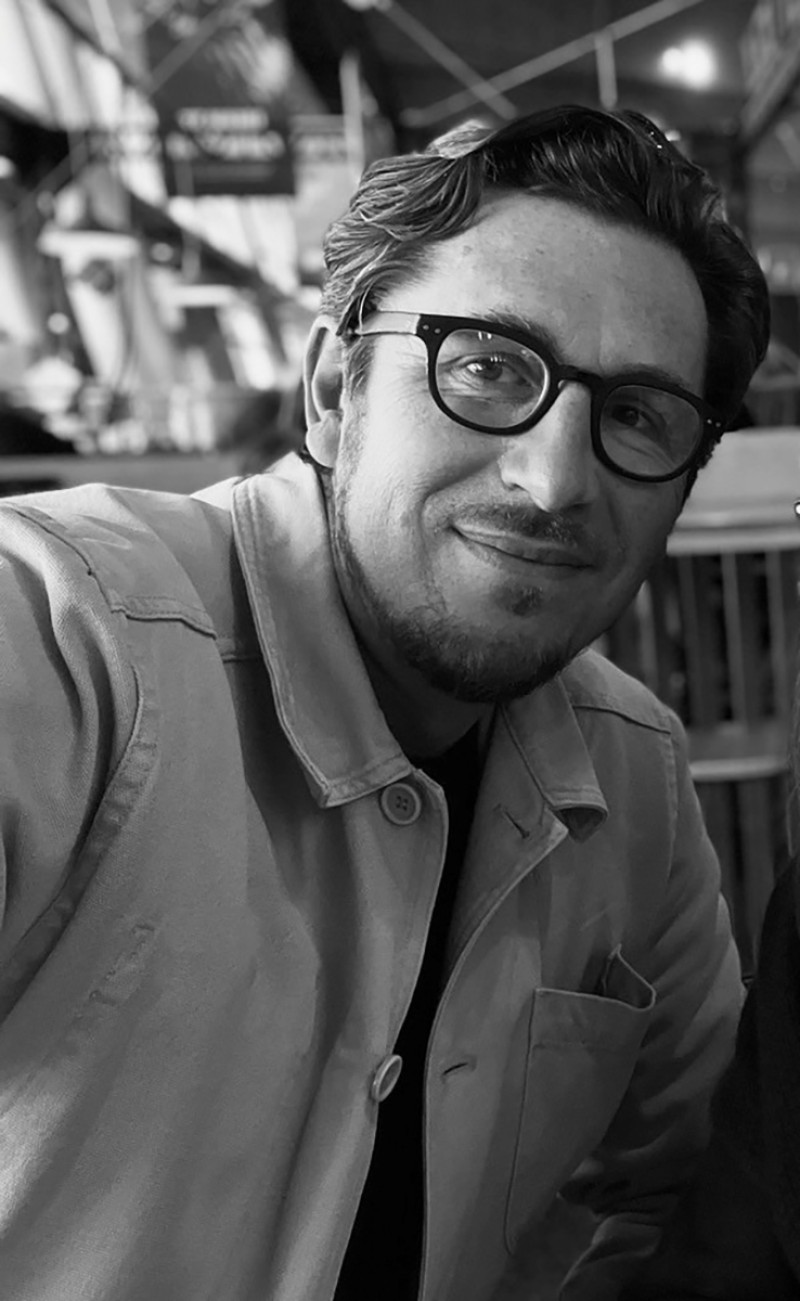
Joe Sheehan
Walk the Line by Isabella Smith
In this new series, Isabella Smith talks to the artists behind the sculptures dotted around our city.
A cenotaph, like the one beside The Beehive, is concerned with memory, acting as a physical embodiment and reminder of what is no longer there. On a quiet morning, when the rush of the daily commute is over and the sound of traffic faded, you might stand beside the war memorial and hear a trickling, burbling sound of water, as though a stream were running beneath your feet.
Look down and you’ll notice a string of jewel-like discs of pounamu and jade embedded in the pavement, snaking elegantly through the precinct. The pounamu map the path of the Waipiro Stream which once flowed down Bowen Street toward the nearby shoreline, but – like many streams in Wellington – is no longer there, having been culverted to run beneath Bowen Street, Lambton Quay, Whitmore Street, and out into the harbour.
“Water is the original stone carver,” says artist and jeweller Joe Sheehan, whose love affair with pounamu and jade began over three decades ago.
Pounamu from Aotearoa is alluvial, occurring as boulders and cobbles in the rivers of the West Coast of Te Waipounamu. For Joe, it felt like the obvious material to use in honouring the Waipiro Stream. “I wanted the sound of the stream to fill the space and create a ghost river, responding to the nature of the site as a war memorial,” he says. “It felt right to try to somehow release the spirit of the stream in this way.”
The Wellington Sculpture Trust commissioned Walk the Line as part of the redesign of the Cenotaph memorial precinct in 2015. With 231 pieces of pounamu and jade in total, the work features stones gifted to and collected by Joe from Aotearoa, Australia, Canada, Russia, America, Mongolia, and China over 15 years.
Each piece is unique; varying in colour, pattern, translucency, and hardness. “Having this range of material meant my line could operate as a kind of League of Nations,” he says. “To me, [jade and pounamu] function as a kind of connective tissue within the cultures that have used it, binding people to one another through shared histories, values, and traditions.”
The Cenotaph memorial precinct is one of the busiest intersections in the city. A transitory place, almost tidal in its filling and emptying during the working week. Each morning and evening, thousands of commuters hop off and on trains and buses, crossing the precinct on their way to the office or home. Over time, the stones have naturally gained a patina and shine as innumerable pairs of shoes cross the line each day.
During those busy mornings and evenings, the visual aspect of the sculpture comes to the forefront while the sound slips into the background. “The challenge was to make these small gestures fill the entire area and for it to work at night also. The approach I took was for the visual elements to work the day shift, with people following and crossing this line as they moved through the space, while the soundtrack would work the night shift.”
14 underground speakers sit beneath small grates embedded in the site. Together with sound editors Martin Kwok and Chris Ward, Joe recorded the sound of streams on and around Te Ahumairangi Hill that feed into the Waipiro Stream. They captured the recordings between one and three in the morning, “standing very quietly and actively listening to these small bodies of water. It was one of the most beautiful parts of making the work,” Joe tells me. They then mixed the recordings into a soundtrack that plays continuously through the speakers, allowing the water to be heard but never seen.
The speakers presented technical challenges, with the grates also functioning as stormwater drains. To protect the speaker system, Joe, Martin, and Chris installed them below ground with stainless-steel reflectors to project the sound upwards. During the occupation of New Zealand Parliament lawns, nine of the speakers sustained significant damage when they were pulled from the ground, with protestors believing them to be listening devices.
Walk the Line is a sculpture concerned with the traces we leave behind – both physical and intangible. The title comes from Robert Frost’s Mending Wall, a powerful meditation on the nature of relationships and boundaries. The poem “felt appropriate for a war memorial site and the site of a stream which was, I was told, a boundary line for local hapu,” Joe says. “The title felt like it brought together these ideas of separation and connection, of lines drawn through landscapes and the relationships that exist on either side of them.”
Discreet and lyrical, the work is enjoyed by those who pay attention to their surroundings. “Quite often the busy parents pass through completely oblivious and miss it, but the kids always get it. It gives me the greatest pleasure to see them hop, skip, and walk the line.”
Public art is often conceived of in terms of scale; there is an assumption that a sculpture should fill the dimensions of the space it occupies. But it is the quietude of Walk the Line that makes it so touching upon discovery. Its resistance to scale, particularly when its neighbours are the parliament grounds and buildings, is what gives the work its power. “This is what happens when you give someone with a jewellery background a public artwork to make, I guess,” Joe says. “You get something intimate and understated where details are important.”
When I ask him about what role public art should play in society, he says, “Good public art should reveal something. Beyond marking and commemorating, it should illuminate. The thing that gives you a knock as you walk through the city on your way to work doesn’t have to be monolithic. Sometimes the smallest interventions stay with you the longest. I’d like to see more of this, and more public art generally. Art should be everywhere.”
View more articles from:
« Issue 273, July 28, 2026