

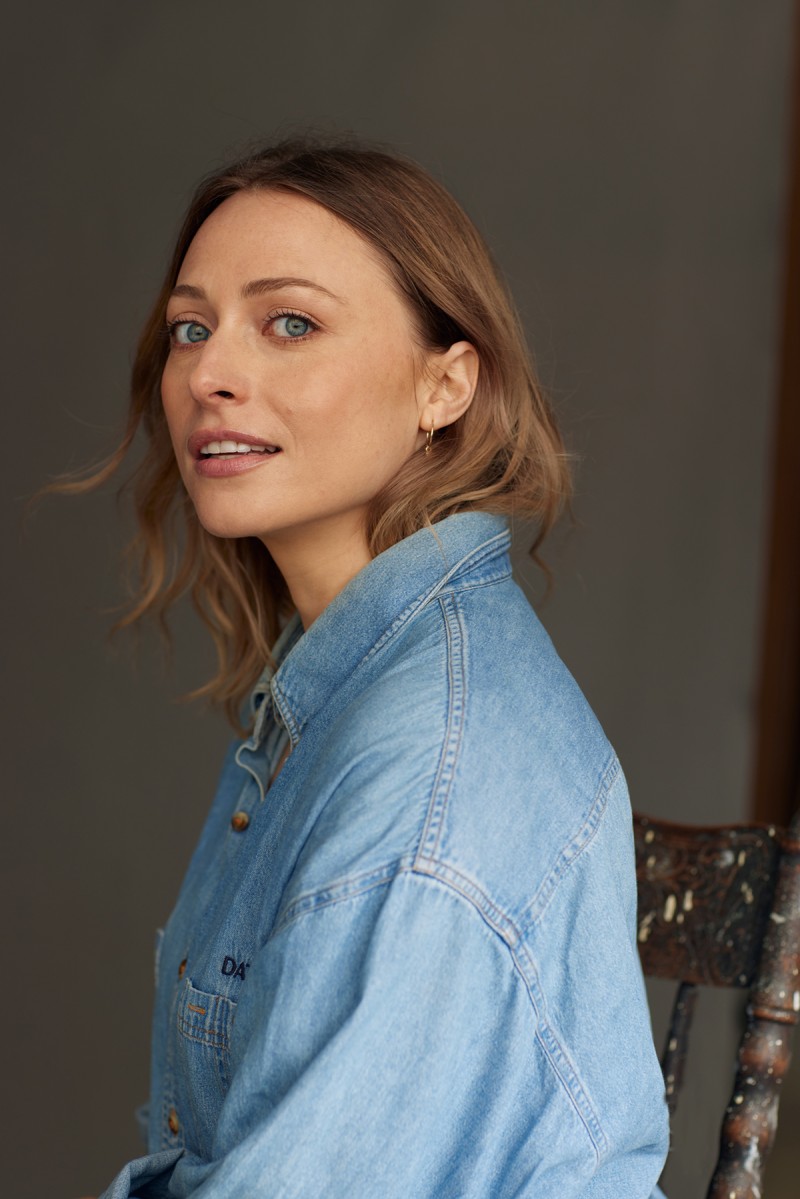
Chelsie Preston Crayford
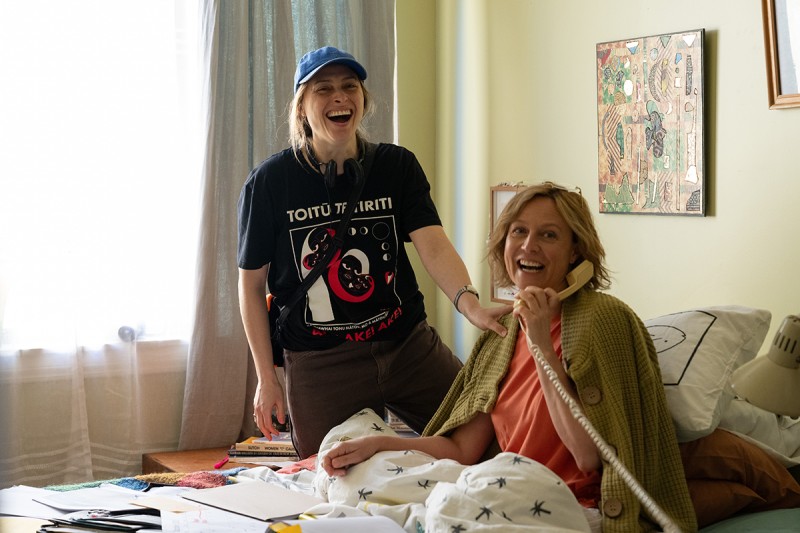
Chelsie Preston Crayford and Marta Dusseldorf
Wellington Silver Screeners: Chelsie Preston Crayford by Alessia Belsito-Riera
In our Wellington Silver Screeners series, Alessia Belsito-Riera shines a spotlight on the movers and shakers working in the film capital of New Zealand.
“By the time Caterpillar is in cinemas, it will have been with me for eight years,” Chelsie Preston Crayford tells me. “This is the first interview I’m doing about it. So, I kind of feel emotional!”
Feeling privileged to have been the first to chat with the actor and filmmaker, I can’t help but realise the full-circle moment this interview is for me. Not only is Caterpillar a film shot and set in Te Whanganui-a-Tara that is written and directed by a Wellingtonian, making it an unequivocally perfect instalment for our Silver Screeners series, but it is also a story about three generations of women living under the same roof. A tale that echoes my own.
“That’s so cool that you grew up in a similar situation,” Preston Crayford beams. “I struggle to find films that had that family dynamic.”
Ahead of Caterpillar’s release in May, read all about the creative powerhouse behind it, along with her passions, her intentions, and her own story that inspired it below.
What sparked your interest in filmmaking? What do you love about it?
I’ve been an actor for all my life, really. And what we do as actors is we come onto a project that’s already developed and formed, and we lend our voices to the wider vision. Sometimes you’re really aligned with it and many times you’re not and what you end up doing – particularly when roles for women are written by men – is massaging the writing to make characters feel like real women and stories feel believable. Filmmaking, for me, was about having total agency of my voice.
What have been some career highlights so far?
Definitely making this film is one of the hardest and most rewarding things I’ve done, aside from having children. My main career highlight is that I have not had to have another job. It’s really, really, really challenging to survive as a creative in New Zealand and particularly as an actor, so there have been times that it’s been hairy, but for a long time I’ve managed it. There are characters that I’ve really loved playing, there are amazing things that I’ve done, but the main thing for me is having been able to sustain a really fulfilling creative life and family life at the same time, because I wasn’t sure that was even a possibility. I felt like it was one or the other when I was growing up and it doesn’t have to be. That was kind of my life goal.
What prompted you to shift into directing? Was it something you’d always had a passion for?
No, it wasn’t something that I consciously thought about in terms of the job title. It was more just a means of telling my story. I’m open to what the future holds, but I don’t necessarily have designs on directing other people’s projects. For me, it’s just about having a voice. We all have stories to tell and that’s what it was more about for me.
Tell me about your film, Caterpillar. What’s it about?
It’s a multi-protagonist story that follows three generations of women all living under one roof together. They’re all at three very different, very pivotal life stages, and all of their needs are colliding as they often do in families. The story is about a time when their family is changing forever and how they all navigate that together and also in spite of each other.
I’m still not totally sure that my film passes the Bechdel Test in reverse. The cast is 90 percent women; there are some really amazing men in it as well. The story wasn’t super intentional, and though it’s obviously what I am interested in bringing to life, it wasn’t pointed. I grew up in a matriarchy and what fascinated me was the complexity of female relationships, as I’m a mother and a daughter, and how we balance our many roles as women and the expectations that come with them.
What was your experience writing this story?
It was one of the hardest things I’ve ever done. It’s really hard to write a feature film and screenplays. It blows my mind how saturated with content we are because that’s the mind bend of film – you take years and years of your life and so much of yourself goes into it and then it’s just this 90-minute thing that some people will see and many people won’t see. Some people might watch it on a plane. It’s pretty wild to think how much goes into all the stories that we get to watch. Over the course of those years that I was developing it, I was also working as an actor, which sort of became my day job, and raising my daughter. I felt like I was living what the film was about as I was writing it. Writing was a learning curve for me anyway. For me to actively do something that I’m not good at yet is so uncomfortable. Especially if you’re reasonably confident in your field. It was really scary. There were some parts of the film that I couldn’t write until I had learned them myself. For the climax of the film, I had a placeholder in that scene for years. I knew the structure, but I didn’t know how to write it. It wasn’t until I learned something through my relationship with my daughter that I could write it. I feel like these things are always showing up to teach you something as you’re writing about them.
It sounds like a very personal, intimate process for you.
Yeah, massively. And also quite organic. I couldn’t force things. I was annoyed with myself the whole time I was writing about it because it wasn’t a super conscious choice to write. When you start out on something, you don’t know what it is. The whole exploration of writing is finding out what it is and why this thing is presented to you. It’s like pulling on a thread and your job becomes servicing the needs of the story. I was like, ‘Why did I choose a multi-protagonist story as my first film to write?’ It was challenging to write something that felt complex, but not complicated while balancing all the characters. How do you tell a story that is driven by one of the characters getting an illness that takes time, in 90 minutes? How do you deal with time? How do you weave something in a way that gets your meaning across? Now I feel like I started on a hard level, so when I go back in the video game, the next film will have a single protagonist and it’ll be really simple! I wrote some TV, an episode of Double Parked, which was such a joy – it felt so easeful and pleasurable because all of the beats are written out for you, you know exactly what you have to do, and the characters exist. I wasn’t wrestling the story.
How was filming in the capital? How would you describe Wellington’s film industry?
So good. I don’t really think of the Wellington film industry as separate. New Zealand’s film industry is reasonably small and also excellent, so it was cool working in Wellington. It was very nostalgic. I drew a lot from my life growing up and the film is set in that world. It’s a work of fiction, but it has grown from my life, my experiences, and my relationships. [Wellington] being where it grew from was essential. It’s so specific. It was raised whether I could do this somewhere else, and that was a no, a deal breaker for me. It was a no brainer because, to quote Dennis Denuto, it’s the vibe of the thing, you know? Some of the film we shot down the road from my mum’s house that I grew up in. It was so engrained in the fabric of the film, so it had to be in Wellington.
What advice would you give someone who’s starting out in the industry or wants to embark on their own project?
Oh my God. I don’t know if I'm really qualified to give advice, but you have to keep going. It’s such a massive undertaking to tell your stories and I think you just have to do the next part. It’s like, don’t look at the mountain, just take the next step, whatever that is. That’s the only way to really bite off something like that. You don’t have to know how it’s all going to pan out, you just have to take one step at a time.
Once Caterpillar is out there in the world, what’s next for you?
I’ve been shooting since November and I’ve had to take time off to release Caterpillar and then I go back and finish the job, which is season two of a show I do called A Remarkable Place to Die in Queenstown. So, the juggle is real!
View more articles from:
« Issue 267, May 5, 2026